
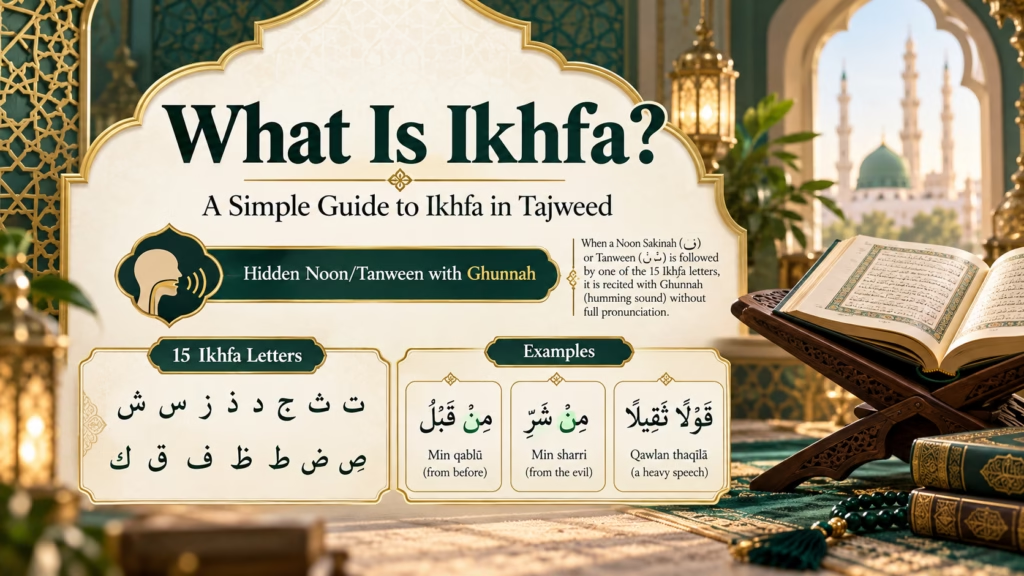
When learning Tajweed, one of the first rules you may encounter is Ikhfa. The name can sound difficult at first, but the rule itself becomes quite simple once you understand when and how it is used.
So, what is Ikhfa?
Ikhfa is a Tajweed rule that applies when Noon Sakinah (نْ) or Tanween (ً ٍ ٌ) comes before one of 15 specific Arabic letters. Instead of pronouncing the “n” sound fully, it is partially concealed and read with a soft nasal sound known as ghunnah.
In this guide, we will explain the meaning of Ikhfa, its 15 letters, pronunciation method, Quranic examples, and the common mistakes beginners should avoid.
What Does Ikhfa Mean?
The Arabic word Ikhfa (إخفاء) means hiding or concealing.
In Tajweed, it refers to hiding the sound of Noon Sakinah or Tanween without removing it completely.
The sound is neither completely clear, as in Izhar, nor completely merged, as in Idgham.
Instead, the Noon sound is pronounced in a concealed way with ghunnah.
This makes Ikhfa a middle position between clear pronunciation and complete merging.
What Is the Rule of Ikhfa?
The rule of Ikhfa is straightforward:
If Noon Sakinah or Tanween is followed by one of the 15 Ikhfa letters, the Noon sound should be concealed and pronounced with ghunnah.
For example:
مِنْ قَبْلُ
Here, نْ is followed by ق.
Since Qaf is one of the Ikhfa letters, the Noon is not pronounced as a strong, clear “n.” Instead, it is concealed while maintaining a nasal sound.
These rules are part of the wider topic of Noon Sakinah and Tanween, which also includes Izhar, Idgham, and Iqlab.
What Is Noon Sakinah?
Noon Sakinah (نْ) is the Arabic letter Noon carrying a Sukoon.
It may occur in the middle or at the end of a word.
For example:
مِنْ
The Noon carries a Sukoon, so it is called Noon Sakinah.
The Tajweed rule applied to it depends on the letter that comes after it.
What Is Tanween?
Tanween is the double vowel marking that appears at the end of some Arabic words.
The three forms are:
ً — Fathatain
ٍ — Kasratain
ٌ — Dammatain
When continuing the recitation, Tanween produces an “n” sound.
If the next letter is one of the Ikhfa letters, that “n” sound is concealed with ghunnah.
How Many Ikhfa Letters Are There?
There are 15 letters of Ikhfa:
ت ث ج د ذ ز س ش ص ض ط ظ ف ق ك
These are:
- ت — Ta
- ث — Tha
- ج — Jeem
- د — Dal
- ذ — Dhal
- ز — Zay
- س — Seen
- ش — Sheen
- ص — Sad
- ض — Dad
- ط — Taa
- ظ — Dhaa
- ف — Fa
- ق — Qaf
- ك — Kaf
If any of these letters appears directly after Noon Sakinah or Tanween, the Ikhfa rule applies.
How to Pronounce Ikhfa Correctly
The most important part of Ikhfa is learning how to produce the sound correctly.
When Ikhfa occurs:
- Do not pronounce Noon as a completely clear ن.
- Do not merge it entirely into the following letter.
- Keep a nasal sound through the nose.
- Hold the ghunnah for approximately two counts.
- Prepare the tongue and mouth for the letter that follows.
For example:
مِنْ شَرِّ
The Noon Sakinah comes before ش.
Instead of clearly saying the Noon, the sound is concealed with ghunnah before pronouncing Sheen.
Correct pronunciation also depends on good Quran recitation habits, especially careful listening, repetition, and gradual practice.
What Is Ghunnah in Ikhfa?
Ghunnah is the nasal sound used in several Tajweed rules.
It comes primarily through the nasal passage rather than the mouth.
In Ikhfa, ghunnah is usually held for approximately two counts.
It should sound natural rather than exaggerated.
Why Makharij Matters in Ikhfa
Ikhfa does not only depend on ghunnah. The following letter must also be pronounced from its correct articulation point.
This is why learning Makharij of Arabic letters is important for clear Quran pronunciation. Makharij refers to the places in the mouth, throat, tongue, and lips from which Arabic letters are produced.
Examples of Ikhfa With Noon Sakinah
Noon Sakinah Before Ta
أَنْتُمْ
The Noon Sakinah is followed by ت.
Because Ta is an Ikhfa letter, Ikhfa is applied.
Noon Sakinah Before Sheen
مِنْ شَرِّ
The Noon Sakinah comes before ش, so it is concealed with ghunnah.
Noon Sakinah Before Qaf
مِنْ قَبْلُ
Here, Noon Sakinah is followed by ق, another Ikhfa letter.
Noon Sakinah Before Tha
مِنْ ثَمَرَاتٍ
The letter after Noon Sakinah is ث, so the Ikhfa rule applies.
Examples of Ikhfa With Tanween
Ikhfa also occurs with Tanween.
For example:
قَوْلًا ثَقِيلًا
The Tanween at the end of قَوْلًا is followed by ث.
Because Tha is an Ikhfa letter, the Tanween sound is concealed with ghunnah.
Ikhfa With Heavy and Light Letters
Not every Ikhfa sounds exactly identical.
The character of the ghunnah can be influenced by the letter that follows.
For example, letters such as:
ص، ض، ط، ظ، ق
have a heavier quality.
With lighter letters such as:
ت، س، ف، ك
the pronunciation is lighter.
A beginner does not need to overcomplicate this. These differences become easier through listening and repeated Tajweed practice.
Why Is Ikhfa Important in Tajweed?
Ikhfa helps maintain the correct flow and pronunciation of Quranic recitation.
Understanding this rule can help students:
- recognize Noon Sakinah and Tanween correctly
- improve their ghunnah
- avoid overly clear or merged Noon sounds
- read Quranic words more smoothly
- distinguish between the major rules of Noon Sakinah and Tanween
Tajweed should ultimately be applied during actual recitation, not memorized only as theory.
Ikhfa vs Izhar
Izhar means making the sound clear.
When Noon Sakinah or Tanween is followed by an Izhar letter, the Noon sound is pronounced clearly without concealing it.
In Ikhfa, however, the Noon sound is partially hidden.
Izhar = clear
Ikhfa = concealed
Ikhfa vs Idgham
Idgham means merging.
In Idgham, the Noon Sakinah or Tanween merges into the letter that follows.
In Ikhfa, the sound is only concealed rather than completely merged.
Ikhfa = hiding
Idgham = merging
Ikhfa vs Iqlab
Iqlab occurs when Noon Sakinah or Tanween comes before ب.
Instead of keeping the Noon sound, it changes into a concealed Meem-like sound with ghunnah.
Therefore:
نْ or Tanween + ب = Iqlab
نْ or Tanween + one of the 15 Ikhfa letters = Ikhfa
These are among the core Tajweed rules for beginners that students normally learn gradually rather than all at once.
A Simple Way to Identify Ikhfa While Reading
Whenever you see Noon Sakinah or Tanween, look immediately at the next letter.
Ask:
Is the next letter one of the 15 Ikhfa letters?
If yes, apply Ikhfa.
Remember:
Noon Sakinah / Tanween + Ikhfa letter → concealed Noon sound + ghunnah
Common Ikhfa Mistakes
Pronouncing a Full Noon Sound
If the Noon is pronounced too clearly, the sound becomes closer to Izhar.
Removing the Noon Completely
Ikhfa does not mean deleting the sound. Ghunnah must remain.
Holding Ghunnah Too Long
Ghunnah is generally held for about two counts.
Ignoring the Following Letter
Correct Ikhfa should flow naturally into the next letter, so proper articulation remains important.
How Can Beginners Practice Ikhfa?
Start by memorizing the 15 letters.
Then practice combinations such as:
نْ + ت
نْ + س
نْ + ش
نْ + ق
نْ + ك
After that, move to complete Quranic words and verses.
Beginners who are still building Arabic reading foundations can also benefit from a Noorani Qaida course before moving into more detailed Tajweed rules.
Is Reading About Ikhfa Enough?
Reading explanations helps you understand when Ikhfa occurs, but Tajweed is primarily a practical skill.
Correct pronunciation becomes easier through:
- listening
- repetition
- teacher correction
- regular recitation
- applying the rule in Quranic verses
This is why learning to read Quran with Tajweed combines rule recognition with practical recitation.
Easy Ikhfa Rule to Remember
When Noon Sakinah or Tanween comes before any of the 15 Ikhfa letters, conceal the Noon sound and pronounce it with ghunnah for about two counts.
The letters are:
ت ث ج د ذ ز س ش ص ض ط ظ ف ق ك
Frequently Asked Questions
What is Ikhfa in Tajweed?
Ikhfa is a Tajweed rule in which the sound of Noon Sakinah or Tanween is partially concealed when followed by one of 15 specific letters.
What does Ikhfa mean?
Ikhfa means to hide or conceal.
How many Ikhfa letters are there?
There are 15 Ikhfa letters:
ت ث ج د ذ ز س ش ص ض ط ظ ف ق ك
How long is Ikhfa ghunnah?
The ghunnah is generally held for approximately two counts.
Does Ikhfa apply to Tanween?
Yes. Ikhfa applies to both Noon Sakinah and Tanween.
What is the difference between Ikhfa and Izhar?
Izhar uses a clear Noon sound, while Ikhfa partially conceals it with ghunnah.
What is the difference between Ikhfa and Idgham?
Ikhfa conceals the sound, while Idgham merges it into the next letter.
Which letter causes Iqlab?
The letter ب (Ba) causes Iqlab when it follows Noon Sakinah or Tanween.
Conclusion
Ikhfa is an important Tajweed rule that occurs when Noon Sakinah or Tanween comes before one of 15 Ikhfa letters.
The Noon sound is neither pronounced completely clearly nor fully merged. Instead, it is partially concealed with ghunnah for approximately two counts.
Remember:
Noon Sakinah or Tanween + Ikhfa letter = concealed sound with ghunnah
With regular practice, correct Makharij, and careful Quran recitation, recognizing and applying Ikhfa becomes much easier.