
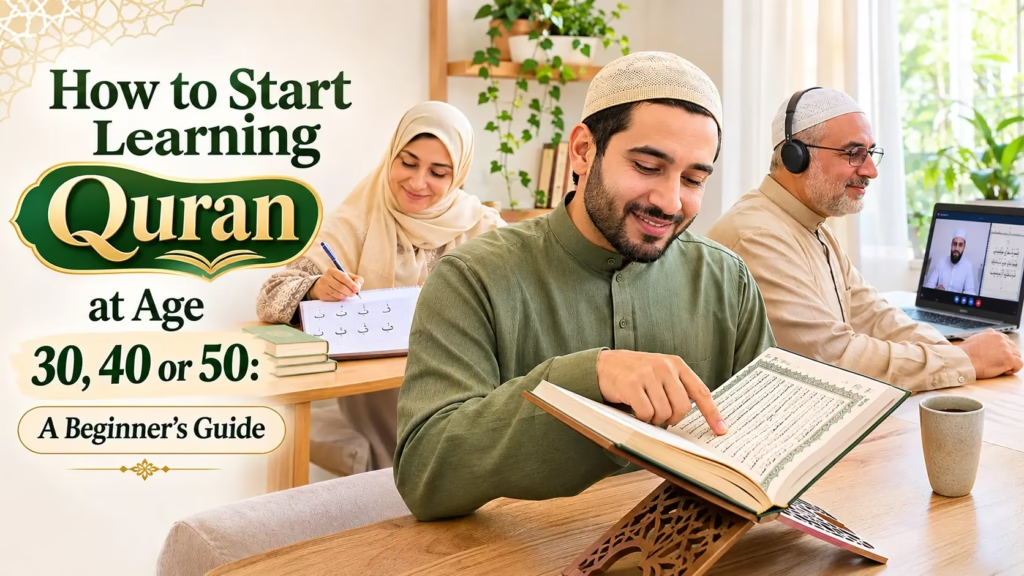
Have you ever listened to someone recite the Quran beautifully and wished you could read it that way, too?
Perhaps you learned a few Arabic letters as a child but never continued. Maybe you can read some verses, but you’re unsure whether your pronunciation is correct. Or perhaps you’ve reached your 30s, 40s, or 50s and are wondering whether it’s too late to begin.
If any of these situations sound familiar, you’re certainly not alone in having these concerns.
Starting something new as an adult can feel uncomfortable, especially when it involves a skill you think you should have learned years ago. But learning the Quran isn’t a race, and you don’t need to compare your starting point with anyone else’s.
You can start learning the Quran at 30, 40, 50, or later. The most practical approach is to assess your current reading ability, begin with Arabic letters and pronunciation if necessary, learn basic Tajweed gradually, and establish a consistent practice routine. A qualified Quran teacher can help you identify mistakes and progress at a comfortable pace.
You don’t need to know Arabic before your first lesson. You don’t need to memorize long surahs immediately. And you certainly don’t need to become a perfect reciter before feeling that your efforts matter.
You simply need a suitable starting point and a willingness to keep learning.
Is It Too Late to Learn the Quran at 30, 40, or 50?
No. There is no age limit for beginning Quran education.
Although children often have more free time for learning, adults bring valuable qualities of their own. They may have a clearer sense of purpose, stronger motivation, and a better understanding of why learning matters to them.
Of course, adult learning has its challenges. You may have a full-time job, children to care for, household responsibilities, or limited energy after a busy day.
You might also feel nervous about making mistakes in front of a teacher.
These concerns are understandable, but none of them prevents you from starting.
The Quran itself offers encouragement:
وَلَقَدْ يَسَّرْنَا الْقُرْآنَ لِلذِّكْرِ فَهَلْ مِنْ مُدَّكِرٍ
“And We have certainly made the Qur’an easy for remembrance, so is there any who will remember?”
— Surah Al-Qamar (54:17), Sahih International translation.
This verse encourages reflection and engagement with the Quran. It doesn’t mean every aspect of Quran learning will be effortless, but it reminds us that the Quran is meant to be approached, remembered, and reflected upon.
Whether you’re beginning at 30 or returning to Quran reading at 50, your journey can start with a single lesson.
How to Start Learning the Quran as an Adult: 7 Practical Steps
If you’re unsure where to begin, follow these seven steps. They provide a foundation that can be adjusted to your reading ability, goals, and available time.
Step 1: Identify Your Current Quran Reading Level
Before buying books or enrolling in a course, take a moment to understand what you already know.
Ask yourself:
- Can I recognize the Arabic alphabet?
- Can I pronounce individual Arabic letters?
- Do I understand the basic vowel marks, such as Fathah, Kasrah, and Dammah?
- Can I join Arabic letters to read words?
- Can I read short Quranic verses without relying entirely on transliteration?
- Do I need help with Tajweed and pronunciation?
Your answers will help determine your starting level.
For example, if you cannot recognize Arabic letters, a beginner’s Qaida course is a sensible place to start. If you can already read the Quran but struggle with pronunciation, you may benefit more from guided recitation and Tajweed lessons.
A useful tip: Ask a qualified teacher to listen to a short reading sample. Even a brief assessment can reveal difficulties that you may not notice yourself.
Starting at the correct level is much more helpful than choosing an advanced course simply because of your age.
Step 2: Learn the Arabic Alphabet and Basic Pronunciation
If you’re a complete beginner, begin with the Arabic alphabet.
Arabic has 28 basic letters, and some sounds may be unfamiliar if your first language is English, Urdu, or another non-Arabic language.
For instance, the letters ح (Ha), خ (Kha), ع (Ayn), and ق (Qaf) require particular attention to their articulation.
Don’t worry if you cannot pronounce them correctly on your first attempt.
Start by learning to recognize each letter, listen carefully to its sound, and repeat it with guidance.
Many beginners use Noorani Qaida or Madani Qaida to develop their reading foundation. These learning materials introduce letters, vowel marks, joining patterns, and other basic reading skills in a structured sequence.
You can begin with just a few letters at a time.
The goal is not to finish the alphabet as quickly as possible. It is to recognize the letters confidently and develop accurate pronunciation habits.
Step 3: Learn to Read Arabic Words Before Long Quranic Verses
Once you recognize the letters, begin combining them into simple words.
This stage is particularly important because recognizing individual letters and reading connected Arabic text are different skills.
At first, you may need to pause between sounds. You may confuse similar letters or forget a vowel mark you learned the previous day.
That’s part of the learning process.
Practice short combinations until you become more comfortable reading them. Then gradually move toward longer words and short verses.
Try not to rely exclusively on English transliteration. It can be a temporary aid, but it does not represent every Arabic sound accurately.
Your long-term goal should be to read directly from the Arabic text, with appropriate teacher guidance.
Step 4: Introduce Tajweed Gradually
Tajweed refers to the rules and principles used to recite the Quran with correct pronunciation and articulation.
For adult beginners, Tajweed may initially sound complicated. Terms such as Makharij, Ghunnah, Madd, Ikhfa, and Idgham can feel unfamiliar.
You do not need to master all these rules immediately.
Start with the fundamentals:
- Makharij: Where Arabic letters are articulated.
- Harakat: Short vowel marks that affect pronunciation.
- Madd: Lengthening certain vowel sounds.
- Ghunnah: Nasalization in specific recitation rules.
- Basic stopping rules: Understanding appropriate places to pause.
A good teacher will introduce the relevant rules as your reading develops.
For example, when you learn a word containing a long vowel, your teacher can explain the applicable Madd rule during that lesson rather than requiring you to memorize an entire chapter of theory beforehand.
This approach helps connect Tajweed knowledge with actual Quran recitation.
Step 5: Establish a Realistic Daily Practice Routine
One of the biggest challenges for adult learners is finding time.
You may begin with enthusiasm and plan to study for an hour every day. But after a demanding week, that schedule can become difficult to maintain.
A smaller routine is often more sustainable.
Consider beginning with 15 to 20 minutes of personal practice per day, adjusting the duration to your needs.
Here’s an example of a 20-minute practice session:
| Activity | Time |
|---|---|
| Review previously learned letters or words | 5 minutes |
| Practice the current lesson | 7 minutes |
| Listen to correct recitation and repeat | 5 minutes |
| Review mistakes and prepare questions | 3 minutes |
You can practice after Fajr, during a quiet afternoon, or before going to bed.
The best time is one you can maintain regularly.
If you miss a day, don’t abandon your plan. Continue with the next available session.
Consistency matters more than creating a perfect schedule that lasts only one week.
Step 6: Learn With a Qualified Quran Teacher
Self-study resources can be useful, but they have limitations.
You may listen to a reciter and repeat a word several times without realizing that you’re pronouncing one of its letters incorrectly.
A qualified teacher can identify these mistakes and explain how to correct them.
This is especially helpful for Arabic sounds that are unfamiliar to you.
When choosing a Quran teacher, look for someone who:
- Has suitable knowledge of Quran recitation and Tajweed.
- Can teach complete beginners patiently.
- Explains lessons in a language you understand.
- Corrects mistakes respectfully and clearly.
- Adjusts the pace according to your progress.
- Provides structured lessons and regular feedback.
If you feel uncomfortable learning in a group, one-to-one Quran classes may be a better fit.
Private lessons allow you to ask questions, repeat difficult sounds, and practice without worrying about keeping up with other students.
For adults managing work and family responsibilities, online Quran classes can also provide convenient access to teachers without traveling to a physical learning center.
Step 7: Review Your Progress and Set Small Goals
Progress becomes easier to recognize when you have specific, achievable goals.
Instead of telling yourself, “I want to read the entire Quran fluently as soon as possible,” divide your learning into smaller milestones.
Your initial goals might include recognizing all Arabic letters, reading simple words, understanding basic pronunciation rules, and reciting a short surah with teacher guidance.
Review your progress every few weeks.
Ask yourself what has improved, which letters remain difficult, and whether your practice routine still fits your schedule.
You may discover that some lessons require more repetition than others. That’s perfectly normal.
The purpose of reviewing progress is to improve your learning plan, not to judge yourself against someone else’s speed.
Learning the Quran at 30 vs 40 vs 50: What Changes?
The fundamentals of Quran learning remain the same at every age. However, your responsibilities, previous experience, and learning preferences may influence your approach.
| Starting age | Common situation | Suggested approach |
|---|---|---|
| In your 30s | Balancing career, family, and personal development | Set fixed lesson times and use short daily practice sessions |
| In your 40s | Returning after a long break or learning alongside children | Begin with a reading assessment and focus on correcting existing habits |
| In your 50s | Starting a long-held personal goal or revisiting earlier learning | Choose a comfortable pace, repeat lessons as needed, and prioritize clarity |
These are examples, not fixed characteristics of particular age groups.
A complete beginner at 30 may need more foundational instruction than an experienced reader at 50.
Your existing knowledge and learning needs are more important than your age alone.
How Long Does It Take an Adult to Learn to Read the Quran?
There is no universal timeline.
Learning the Arabic alphabet, reading Quranic words, developing fluent recitation, and memorizing the Quran are different goals. Each requires a different amount of time and practice.
Your progress depends on several factors:
- Whether you already recognize Arabic letters.
- How frequently you attend lessons.
- How consistently you practice between classes.
- Whether you receive accurate pronunciation feedback.
- The complexity of the skills you’re currently learning.
- Your individual learning pace.
Someone who studied Noorani Qaida during childhood may regain basic reading skills relatively quickly.
A complete beginner who has never encountered Arabic letters may need more time to build the same foundation.
Rather than relying on promises such as “Learn Quran in 30 days,” ask your teacher to set milestones based on your initial assessment.
For example, your first milestone might be reading individual Arabic letters accurately. Your next might be reading connected words without transliteration.
These achievements are meaningful even if they take longer than you originally expected.
A Simple 30-Day Quran Learning Plan for Adult Beginners
If you’re starting from zero, the following four-week plan can help you build a routine.
It is an introductory study framework, not a guarantee that you will master every skill within 30 days.
Week 1: Become Familiar With Arabic Letters
Focus on recognizing letters, listening to their sounds, and learning their basic pronunciation.
Practice regularly and ask your teacher to correct difficult sounds.
Goal: Begin identifying Arabic letters and recognizing differences between similar sounds.
Week 2: Practice Vowel Marks and Letter Combinations
Learn how basic vowel marks affect pronunciation and begin reading short combinations.
Continue reviewing the alphabet.
Goal: Start connecting familiar letters with their correct vowel sounds.
Week 3: Read Simple Arabic Words
Practice joining letters and reading short words.
Pay attention to the mistakes your teacher identifies.
Goal: Develop confidence reading simple Arabic words rather than relying only on letter-by-letter recognition.
Week 4: Strengthen Your Reading Foundation
Review previous lessons, practice difficult letter combinations, and attempt suitable short passages with teacher guidance.
Goal: Identify which foundational skills are becoming comfortable and which need further practice.
At the end of the month, discuss your progress with your teacher and create a plan for the next stage.
Some learners will need more time on the alphabet, while others may be ready for more advanced reading practice. Both are valid outcomes.
Can You Learn the Quran Without Knowing Arabic?
Yes. You can begin learning Quran recitation without speaking or understanding conversational Arabic.
However, it helps to distinguish three different learning goals.
Quran reading focuses on recognizing Arabic letters and reciting the written text correctly.
Tajweed focuses on the rules of accurate Quran recitation.
Quran translation and understanding involve studying the meanings of verses, vocabulary, and explanations.
You can begin with Quran reading and gradually add Tajweed and translation studies.
If your primary goal is understanding the Quran’s message, you can also study a reliable translation and explanation while developing your Arabic reading skills.
You don’t have to become fluent in Arabic conversation before engaging with the Quran.
Common Challenges Adult Quran Beginners Face
“I Feel Embarrassed Because I Don’t Know How to Read”
This is one of the most personal challenges an adult beginner may experience.
You might worry that your teacher will judge you or that you should already know the basics.
A professional Quran teacher should respect your starting level and help you learn without embarrassment.
Remember that attending a beginner’s class is a decision to develop a skill, not a test of your worth.
“I Keep Forgetting What I Learned”
Forgetting a newly learned letter or pronunciation rule doesn’t mean you cannot learn.
Try reviewing previous lessons briefly before introducing new material.
If a particular sound remains difficult, ask your teacher for additional examples and repeat it over several sessions.
Short, repeated practice is often easier to maintain than occasional lengthy study sessions.
“My Pronunciation Isn’t Improving”
Some Arabic sounds require careful practice.
Instead of repeating an entire verse while making the same mistake, isolate the difficult sound.
Listen to the correct pronunciation, observe your teacher’s explanation, and practice the sound within simple words before returning to longer passages.
“I’m Too Busy for Regular Quran Classes”
You don’t necessarily need daily formal lessons to begin.
Choose a class frequency that fits your responsibilities and combine it with manageable independent practice.
Two or three well-attended lessons each week may be more useful than scheduling five lessons you frequently miss.
The right routine is one you can sustain.
Should Adults Choose Online or In-Person Quran Classes?
Both approaches can work well.
In-person classes may suit learners who prefer studying at a local mosque or Islamic center and benefit from face-to-face interaction.
Online Quran classes may be more practical for adults who have demanding schedules, limited transport options, or difficulty finding a suitable teacher nearby.
| Factor | Online Quran classes | In-person Quran classes |
|---|---|---|
| Travel | No commute required | Usually requires travel |
| Scheduling | May offer more time options | Depends on local availability |
| Teacher selection | Can provide access to teachers in different locations | Limited to locally available teachers |
| Pronunciation correction | Possible through clear live audio and teacher feedback | Possible through direct interaction |
| Learning environment | Requires a device and reliable internet | Requires attendance at a physical location |
The quality of teaching matters more than the format alone.
If you choose online lessons, make sure they include live interaction, opportunities to ask questions, and individual pronunciation feedback.
Recorded videos can supplement learning, but they cannot independently verify whether you are pronouncing Arabic letters correctly.
How to Choose the Best Online Quran Classes for Adults
Before enrolling in an online Quran course, consider asking these questions:
- Does the academy accept complete adult beginners?
- Can I start with Noorani Qaida or basic Arabic reading?
- Are one-to-one lessons available?
- Can I choose a male or female teacher?
- Does the teacher speak a language I’m comfortable using?
- Will I receive individual Tajweed corrections?
- Are class timings compatible with my time zone?
- Can I attend a trial lesson before enrolling?
- How will my learning progress be assessed?
A trial class can be particularly useful.
It gives you an opportunity to experience the teaching style, explain your goals, and determine whether the pace feels comfortable.
You should leave the trial with a clearer idea of what you need to learn next.
Start Your Quran Learning Journey With Online Quran Pakistan
If you’ve been waiting for the right time to begin learning the Quran, consider taking one small step today.
At Online Quran Pakistan, adult beginners can explore guided Quran learning based on their current reading level and goals.
Whether you’re starting with Arabic letters, returning to Quran recitation after several years, or hoping to improve your Tajweed, the important first step is identifying the right learning pathway.
You can begin by exploring the available Quran courses and contacting the academy to discuss suitable lessons, teacher preferences, scheduling, and trial arrangements.
Explore Online Quran Pakistan and ask about a beginner-friendly Quran lesson.
Frequently Asked Questions About Learning Quran as an Adult
1. Can I start learning Quran at age 40 with no previous knowledge?
Yes. You can start at 40 even if you have never studied Arabic. Begin with letter recognition, basic vowel marks, and pronunciation. A beginner-level Qaida course with teacher guidance is a practical starting point.
2. Is 50 too old to learn Quran reading?
No. You can begin learning Quran reading at 50 or later. Choose lessons suited to your current abilities, practice consistently, and allow yourself enough time to develop each skill.
3. What should an adult learn first when starting the Quran?
A complete beginner should usually begin with the Arabic alphabet, correct letter pronunciation, and basic vowel marks. Once these foundations become familiar, the learner can progress toward connected words and Quranic verses.
4. Can I learn Quran at home without attending a mosque?
Yes. Adults can study at home using online lessons, Qaida materials, listening exercises, and guided practice. Live instruction is especially useful for correcting pronunciation mistakes.
5. How many minutes should an adult practice Quran daily?
A practical starting point is 15–20 minutes of personal practice, if your schedule allows. You can increase or decrease this depending on your needs. Consistency and attentive practice are more important than reaching an arbitrary number of minutes.
6. Do I need to learn Tajweed before reading the Quran?
You can begin learning basic reading and essential pronunciation together. More detailed Tajweed rules can be introduced progressively as your reading develops.
7. Can I learn Quran if I cannot speak Arabic?
Yes. Speaking Arabic is not a prerequisite for beginning Quran reading. You can learn Arabic letters and Quran recitation while receiving explanations in a language you understand.
8. Is it better to learn Quran with a private teacher?
A private teacher can be especially helpful if you prefer individual attention, need frequent pronunciation corrections, or feel uncomfortable learning in a group. However, the teacher’s qualifications and teaching approach remain important.
9. Can adults memorize the Quran after 40 or 50?
Yes. Adults can begin Quran memorization at these ages. A realistic memorization plan should consider reading accuracy, available time, revision needs, and personal goals. There is no single completion timeline that applies to everyone.
10. What if I learned Quran as a child but forgot how to read?
Start with a reading assessment. You may remember more than you expect, but some foundational lessons may need revision. A teacher can help you identify which skills to review before progressing.
Final Thoughts: Your Quran Learning Journey Can Begin Today
You don’t need to wait until you have more free time, feel more confident, or remember everything you learned as a child.
You can begin with one Arabic letter.
You can begin with a short lesson.
You can begin by asking a teacher to assess your reading.
Learning the Quran at 30, 40, or 50 may require patience, but every stage of the journey offers an opportunity to develop your relationship with the words of Allah.
Focus on learning correctly, practicing consistently, and making progress at a pace you can maintain.
Your age does not have to determine when your Quran learning journey begins. Your next step does.
May Allah make learning, reciting, understanding, and acting upon the Quran easy and beneficial for you. Ameen.