
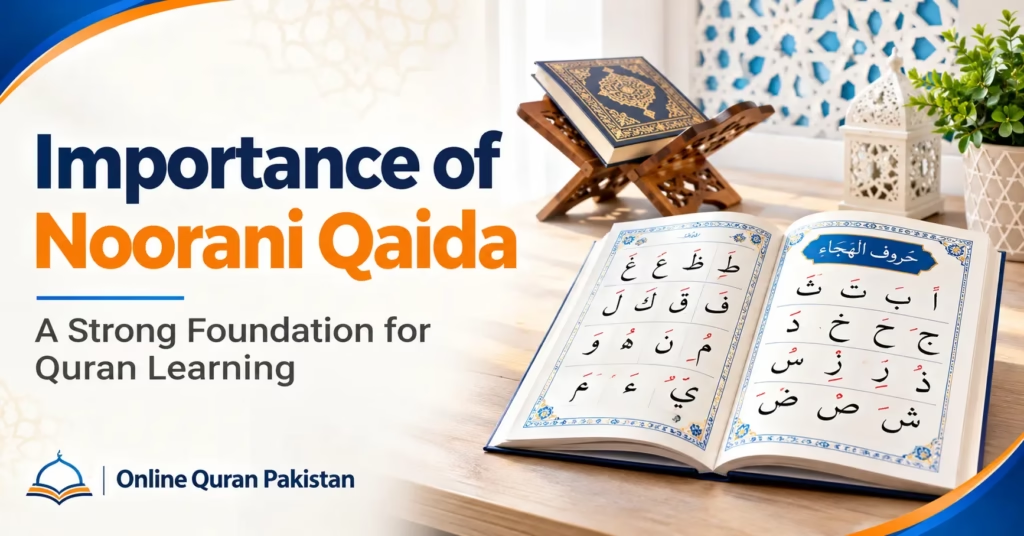
Learning to read the Holy Quran begins with understanding Arabic letters, their sounds, and how they form words. For children and adults unfamiliar with Arabic, this process can seem challenging. Noorani Qaida provides a structured starting point, helping beginners develop the reading and pronunciation skills needed for Quran recitation.
Instead of introducing complete Quranic verses immediately, Noorani Qaida teaches individual letters, vowel marks, connected words, and basic Tajweed principles. Students gradually develop the confidence to recognize Arabic text and pronounce it correctly.
The importance of Noorani Qaida lies in building these essential skills before moving to advanced Quran lessons. Whether you’re teaching your child or starting as an adult, understanding its benefits can help you choose the right learning approach.
What Is Noorani Qaida?
Noorani Qaida is a beginner-level Arabic reading textbook commonly used in Quran schools and Islamic educational institutions. It introduces the Arabic alphabet through progressive exercises that prepare students to read Quranic Arabic.
The book begins with individual letters and gradually introduces vowel marks, connected letters, pronunciation rules, and word-reading exercises.
Its primary purpose is to teach how to read Arabic correctly, not to provide a complete understanding of Arabic grammar or Quran translation.
Students typically develop these skills:
- Recognizing all 28 basic Arabic letters.
- Identifying letters in their different written forms.
- Pronouncing letters from their correct articulation points.
- Understanding Fatha, Kasra, and Damma.
- Reading Sukoon, Shaddah, and Tanween.
- Recognizing short and long vowels.
- Combining letters into complete words.
- Applying introductory Tajweed concepts.
Beginners can explore a structured Qaida course for kids and adults to learn these skills with individual teacher guidance.
Why Is Noorani Qaida Important for Quran Learning?
Arabic contains sounds that don’t exist in many other languages. Beginners may confuse similar letters, overlook vowel marks, or pronounce words incorrectly.
For example, س (Seen) and ص (Saad) represent different Arabic sounds. Likewise, ح and ه have distinct articulation points.
Noorani Qaida introduces these differences early, allowing students to practice correct pronunciation before reading longer Quranic passages.
It also follows a logical learning sequence:
Arabic letters → Vowel marks → Connected letters → Words → Quran reading
Each stage builds on the previous one. A student who understands individual letters but struggles with connected forms needs additional practice before reading complete words.
This structured progression makes Quran learning more manageable and helps prevent recurring reading mistakes.
Key Benefits of Learning Noorani Qaida
Develops Arabic Letter Recognition
The Arabic alphabet contains 28 basic letters. Several share similar shapes, with dots distinguishing one letter from another.
For example:
| Arabic Letters | Main Difference |
|---|---|
| ب، ت، ث | Number and position of dots |
| ج، ح، خ | Presence and position of a dot |
| د، ذ | Dot above ذ |
| س، ش | Three dots above ش |
| ص، ض | Dot above ض |
Noorani Qaida teaches students to recognize these differences through repeated exercises.
Students also learn how letters change appearance when connected within words. This prepares them to recognize unfamiliar Arabic text rather than memorize individual examples.
Improves Arabic Pronunciation
Correct pronunciation is essential for accurate Quran recitation.
Arabic letters originate from specific articulation points known as Makharij. These involve different positions of the tongue, lips, throat, and other speech organs.
For instance, ق (Qaf) uses the back of the tongue, while ف (Fa) involves the lower lip and upper front teeth.
A qualified teacher demonstrates these sounds and corrects pronunciation mistakes.
Students who need additional instruction can continue improving through online Tajweed courses.
Introduces Essential Tajweed Rules
Tajweed refers to the principles governing correct Quran recitation.
Noorani Qaida introduces foundational concepts that students later study in greater detail.
These may include:
- Madd: Lengthening particular vowel sounds.
- Ghunnah: Nasal resonance in specific recitation rules.
- Qalqalah: A characteristic sound associated with certain consonants carrying Sukoon.
- Sukoon: A mark indicating no following vowel.
- Shaddah: A mark representing a doubled consonant.
- Tanween: Double vowel marks producing a final N sound in connected reading.
Learning these concepts gradually prepares students for more detailed Tajweed instruction.
However, completing Noorani Qaida doesn’t mean a student has mastered every Tajweed rule.
Teaches Arabic Vowel Marks
Arabic vowel marks determine how consonants are pronounced.
The three primary short vowels are Fatha, Kasra, and Damma.
| Vowel Mark | Common Name | Example | Approximate Sound |
|---|---|---|---|
| Fatha (َ) | Zabar | بَ | Ba |
| Kasra (ِ) | Zer | بِ | Bi |
| Damma (ُ) | Pesh | بُ | Bu |
Students also learn long vowels, Sukoon, Shaddah, and Tanween.
These marks are important because even small pronunciation changes can affect Arabic words.
For example, عَلِمَ means “he knew,” while عَلَّمَ means “he taught.” The Shaddah changes the word’s grammatical form and meaning.
Understanding these distinctions helps students read Quranic text more accurately.
Strengthens Quran Reading Fluency
Beginners often read slowly because they must identify each letter individually.
With practice, students become more familiar with common letter combinations and vowel patterns.
They gradually learn to combine sounds without stopping after every letter.
However, fluency doesn’t simply mean reading quickly.
Accurate reading should come before speed. Students must pronounce letters correctly, observe vowel marks, and apply the rules they’ve learned.
Regular practice helps develop these abilities.
Makes Quran Learning Easier for Children
Children benefit from lessons that introduce manageable amounts of information.
Noorani Qaida allows teachers to begin with simple letter recognition before introducing more complicated reading exercises.
A child might initially struggle to distinguish ب، ت، and ث. The teacher can focus on these letters until the child recognizes them confidently.
Parents can reinforce learning through short revision sessions, visual exercises, and positive encouragement.
Families seeking structured instruction can explore online Quran learning for beginners.
Helps Adults Begin Quran Learning
Adults can learn Noorani Qaida even without previous Arabic knowledge.
Some adults never studied Arabic during childhood. Others learned basic Quran reading years ago but have forgotten important rules.
Noorani Qaida provides an organized way to develop or refresh these skills.
Adult learners may need extra practice with unfamiliar pronunciation, particularly throat letters and emphatic consonants.
Patient instruction and regular feedback help them progress without unnecessary pressure.
The same approach benefits new Muslims. A dedicated guide to online Quran classes for new Muslims explains how complete beginners can start learning.
What Do Students Learn in Noorani Qaida?
Noorani Qaida organizes reading skills into progressive lessons. The exact sequence can vary between editions, but the essential learning areas remain similar.
| Learning Stage | Main Skills |
|---|---|
| Arabic alphabet | Recognizing and pronouncing letters |
| Connected letters | Identifying different letter forms |
| Short vowels | Reading Fatha, Kasra, and Damma |
| Tanween | Recognizing double vowel marks |
| Long vowels | Distinguishing short and extended sounds |
| Sukoon | Reading consonants without following vowels |
| Shaddah | Pronouncing doubled consonants |
| Basic Tajweed | Applying introductory recitation rules |
| Word reading | Combining learned skills |
A teacher should assess each skill before introducing more difficult material.
For example, students who still confuse short vowels may struggle when learning longer word combinations.
Progress should depend on demonstrated understanding rather than simply completing pages.
How to Learn Noorani Qaida Step by Step
A clear learning routine helps beginners develop consistent reading habits.
Learn the Arabic Alphabet
Start by recognizing individual letters and practicing their correct sounds.
Focus especially on similar-looking letters. Practice identifying them in random order rather than relying only on memorizing the alphabet sequence.
Understand Connected Letters
Learn how Arabic letters appear at the beginning, middle, and end of words.
Students should recognize that the same letter can have different written forms.
Practice Vowel Marks
Study Fatha, Kasra, and Damma before moving to Tanween, Sukoon, and Shaddah.
Practice unfamiliar combinations to confirm that you understand the rules.
Learn Basic Pronunciation Rules
Practice Makharij and introductory Tajweed concepts with teacher guidance.
Listen carefully, repeat the sounds, and correct mistakes before they become habits.
Begin Reading Complete Words
Combine previously learned skills to read Arabic words.
Teachers should introduce unfamiliar examples rather than relying entirely on memorized textbook lines.
Review Regularly
Spend approximately 10–15 minutes reviewing lessons at home when appropriate for your age and ability.
Regular revision supports retention and helps identify skills that need additional attention.
Common Mistakes When Learning Noorani Qaida
Beginners often encounter similar difficulties.
| Common Mistake | Practical Solution |
|---|---|
| Confusing similar letters | Compare shapes and dot positions |
| Incorrect pronunciation | Practice Makharij with a teacher |
| Mixing short and long vowels | Compare vowel durations through listening exercises |
| Ignoring Shaddah | Identify doubled consonants before reading |
| Adding vowels after Sukoon | Practice consonant combinations carefully |
| Rushing through lessons | Advance only after demonstrating accuracy |
| Memorizing without understanding | Read unfamiliar letter combinations |
Consider a child who can recite an entire Qaida page from memory but struggles when the teacher changes the order of examples.
This suggests the child may have memorized the page rather than developed independent reading skills.
A teacher can address the problem by introducing unfamiliar combinations using previously learned letters and vowel marks.
How Long Does It Take to Complete Noorani Qaida?
Completion time varies according to the student’s age, previous knowledge, lesson frequency, and pronunciation ability.
Some students complete the material within a few months, while others need longer.
A practical learning plan might look like this:
| Learning Phase | Example Duration |
|---|---|
| Arabic letters and pronunciation | 3–4 weeks |
| Connected letters | 2–3 weeks |
| Vowel marks | 3–4 weeks |
| Sukoon, Shaddah, and long vowels | 4–6 weeks |
| Reading practice and revision | 4–6 weeks |
These are illustrative estimates, not guaranteed results.
Students attending regular classes and practicing consistently may progress differently from those studying occasionally.
The priority should always be accurate reading.
Noorani Qaida vs. Quran Nazra: What’s the Difference?
Noorani Qaida and Quran Nazra serve different purposes within Quran education.
| Noorani Qaida | Quran Nazra |
|---|---|
| Introduces Arabic reading fundamentals | Focuses on reading the Quran directly |
| Begins with letters and vowel marks | Uses complete Quranic verses |
| Teaches connected letter recognition | Develops applied reading fluency |
| Introduces basic Tajweed concepts | Continues applying Tajweed during recitation |
| Primarily designed for beginners | Usually follows foundational preparation |
Students should move to Quran Nazra when they can recognize letters, apply vowel marks, and read unfamiliar words with reasonable accuracy.
Those who want to continue developing their skills can explore Quran reading and Tajweed classes.
How Parents Can Support Noorani Qaida Learning
Parents don’t need to become Quran teachers to support their children’s progress.
Simple, consistent encouragement can make a meaningful difference.
- Set a regular practice time: Choose a quiet period when your child can concentrate.
- Review assigned lessons: Avoid introducing difficult material before the teacher recommends it.
- Encourage questions: Let children explain which letters or rules they find challenging.
- Avoid comparisons: Every child develops reading skills at a different pace.
- Communicate with the teacher: Ask which areas need additional practice.
- Celebrate improvement: Recognize accurate pronunciation and independent reading.
For example, if your child previously confused three similar letters but now identifies them correctly, acknowledge that progress.
Small improvements contribute to stronger reading skills over time.
Can You Learn Noorani Qaida Online?
Yes. Live online lessons allow students to learn Noorani Qaida with direct teacher guidance.
During a typical class, the teacher demonstrates pronunciation, explains reading rules, listens to the student, and corrects mistakes.
One-on-one instruction allows teachers to adjust the lesson according to individual needs.
Online classes can be particularly convenient for families living in areas without accessible Quran teachers.
However, recorded videos alone cannot always identify pronunciation errors.
Live feedback remains valuable, especially when learning unfamiliar Arabic sounds.
Students can explore available programs through Online Quran Pakistan’s course directory.
Frequently Asked Questions About Noorani Qaida
Is Noorani Qaida Necessary Before Reading the Quran?
Noorani Qaida isn’t the only method of learning Arabic reading. However, it provides a structured foundation for beginners who cannot yet recognize letters or vowel marks.
What Is the Best Age to Start Noorani Qaida?
Many children begin introductory lessons around ages four to six. However, readiness depends on attention span, interest, and individual development rather than a fixed age.
Can Adults Learn Noorani Qaida From Scratch?
Yes. Adults can begin without previous Arabic knowledge. Structured lessons, consistent practice, and pronunciation feedback help them develop foundational reading skills.
How Many Lessons Are in Noorani Qaida?
A commonly used edition contains 17 lessons. However, lesson numbering and organization may differ between editions.
Does Noorani Qaida Teach Arabic Translation?
No. Its primary focus is Arabic reading and pronunciation. Understanding Quranic meanings requires additional language or translation study.
What Should Students Learn After Completing Noorani Qaida?
Most students progress to Quran Nazra. They can then continue studying Tajweed, Quran memorization, translation, or Arabic language according to their goals.
Start Learning Noorani Qaida With Online Quran Pakistan
Beginner-friendly online Quran education
At Online Quran Pakistan, children and adults can begin their Quran learning journey through structured, one-on-one lessons.
Students receive guidance in Arabic letter recognition, pronunciation, basic Tajweed, and connected word reading.
The academy offers qualified teachers, flexible scheduling, and online classes for learners at different levels.
Whether you’re enrolling your child or starting your own lessons, you can explore the available online Quran classes and arrange a free trial to experience the teaching approach.
Conclusion
Noorani Qaida provides the foundational skills beginners need to approach Quran reading with greater accuracy and confidence.
Through Arabic letter recognition, vowel marks, pronunciation practice, and introductory Tajweed, students develop the ability to read connected Arabic words.
Children, adults, and new Muslims can all benefit from this structured approach when lessons match their abilities.
The importance of Noorani Qaida becomes clear when students move beyond memorized exercises and begin reading unfamiliar Quranic words independently.
With patient instruction, consistent revision, and proper pronunciation feedback, learners can build a strong foundation for Quran Nazra and further Quran studies.