
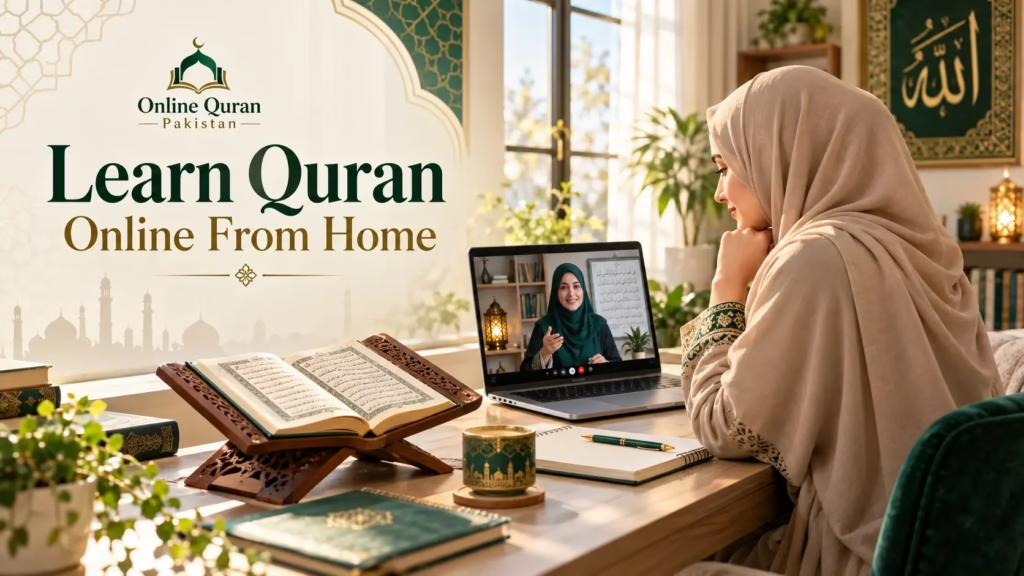
Yes, women can learn Quran online from home through live, one-to-one classes with qualified Quran teachers. Whether you are a complete beginner, a busy mother, a working professional, or someone hoping to improve Tajweed, online Quran learning makes it possible to study the Holy Quran without traveling to a physical classroom.
Many Muslim women want to strengthen their connection with the Quran but struggle to find suitable classes nearby. Others prefer a female Quran teacher, need flexible lesson timings, or feel uncomfortable joining a classroom where students have different levels of experience.
Fortunately, online Quran classes for women offer a practical solution. With a smartphone or computer, a reliable internet connection, and a knowledgeable teacher, you can begin learning Quran from the comfort of your home.
In this guide, we explain how women can learn Quran online, which courses are available, how private lessons work, and what to consider before choosing an online Quran academy.
Can Women Really Learn Quran Online From Home?
Absolutely. Women can study Quran recitation, Tajweed, memorization, Arabic reading, and Quranic understanding through online classes.
Live online lessons allow students to communicate directly with their teachers, read Quranic verses aloud, receive pronunciation corrections, and ask questions.
Unlike prerecorded lectures, one-to-one classes give the teacher an opportunity to identify individual mistakes and adjust lessons according to the student’s ability.
For women who prefer learning with a female instructor, many online academies also offer female Quran teachers.
The most important consideration is not whether learning takes place online or in person. It is whether the student receives accurate instruction, meaningful feedback, and opportunities for consistent practice.
Is It Permissible for Women to Learn Quran Online?
Seeking beneficial Islamic knowledge is encouraged for Muslim women as well as men.
Allah says in the Holy Quran:
وَلَقَدْ يَسَّرْنَا الْقُرْآنَ لِلذِّكْرِ فَهَلْ مِن مُّدَّكِرٍ
“And We have certainly made the Qur’an easy for remembrance, so is there any who will remember?”
Surah Al-Qamar (54:17)
The Prophet Muhammad ﷺ also said:
“The best among you are those who learn the Qur’an and teach it.”
Sahih al-Bukhari, Hadith 5027
These teachings highlight the importance of learning and teaching the Quran.
Online learning is a modern method of education. Whether a particular learning arrangement is appropriate depends on factors such as the teacher, communication, privacy, and Islamic etiquette.
Women who prefer additional privacy can request female instructors and arrange lessons in a suitable environment.
For questions about specific religious circumstances, students can consult a knowledgeable Islamic scholar.
Why Are Online Quran Classes Becoming a Practical Choice for Women?
Women’s daily routines can involve many responsibilities, including employment, university studies, childcare, household activities, and family commitments.
Attending a Quran center at a fixed location is not always convenient.
Online lessons allow learners to access Quran education without adding regular travel to their schedules.
1. Learn From the Comfort of Your Home
One of the main benefits of online Quran classes for ladies is the opportunity to study in a familiar environment.
You can arrange a quiet place in your home, open your Quran or Qaida, and connect with your teacher at the scheduled time.
This can be particularly helpful for mothers with young children, students who live far from Islamic institutions, and women with limited transportation options.
2. Study With a Female Quran Teacher
Many Muslim women feel more comfortable learning with female instructors.
A female Quran teacher can provide individual guidance in Arabic pronunciation, Quran recitation, Tajweed, and memorization.
Students may also find it easier to ask questions, repeat difficult words, and discuss their learning challenges in a comfortable one-to-one setting.
At Online Quran Pakistan, female students can request a female Quran teacher according to course requirements and teacher availability.
3. Choose Class Timings That Fit Your Routine
Online learning offers greater scheduling flexibility than many traditional classroom arrangements.
A mother may prefer lessons while her children are at school. A university student may find evening classes more convenient, while a working woman might prefer weekends.
Available class times depend on the academy and teacher, but online instruction makes it easier to explore options across different schedules and time zones.
4. Receive Personalized Attention
Every student has different learning needs.
Some women are beginning with Arabic letters. Others can already read the Quran but want to improve pronunciation or understand Tajweed rules.
In a one-to-one lesson, the teacher can focus on the areas that need the most attention.
For example, a student who struggles with the pronunciation of ع (Ayn) or ح (Haa) may receive extra exercises before moving to more advanced recitation.
5. Learn at Your Own Pace
Learning Quran is not a competition.
Some students learn quickly, while others need more time to understand Arabic letters, recognize vowel marks, or apply Tajweed rules.
A personalized online course can accommodate these differences.
The goal is to help students develop correct reading skills and confidence rather than simply finish lessons as quickly as possible.
What Quran Courses Can Women Learn Online?
Women can study several Quran-related subjects from home, depending on their current knowledge and learning goals.
Noorani Qaida for Female Beginners
For women who cannot read Arabic, Noorani Qaida provides a structured starting point.
It introduces the Arabic alphabet, letter recognition, vowel signs, joined letters, and essential pronunciation rules.
During beginner lessons, students gradually practice reading Arabic combinations and words before progressing toward Quranic verses.
Adult learners who never had an opportunity to study Quran reading during childhood can begin at this level.
Explore the Noorani Qaida Online Course to learn more about beginner Quran education.
Quran Reading With Tajweed
Women who already recognize Arabic letters can focus on reading the Quran directly.
Tajweed lessons help students understand and apply important recitation rules, including:
- Makharij: Correct articulation points of Arabic letters.
- Madd: Lengthening certain sounds according to recitation rules.
- Ghunnah: Nasalization in specific pronunciation situations.
- Ikhfa: Concealment of certain sounds under defined Tajweed conditions.
- Idgham: Merging sounds in particular recitation patterns.
- Qalqalah: The characteristic echoing sound of certain letters under the relevant conditions.
Learning Tajweed requires both explanation and practice.
A teacher listens to the student’s recitation, identifies errors, and demonstrates how to improve.
Students can explore online Tajweed classes for guided instruction.
Quran Memorization (Hifz) for Women
Women who wish to memorize Quranic Surahs or larger portions of the Holy Quran can also study Hifz online.
Memorization lessons typically include new memorization, revision of recently learned passages, and review of older lessons.
A teacher can listen to recitation and help the learner identify mistakes.
The amount memorized depends on the student’s goals, available study time, and revision consistency.
Some women prefer to begin with short Surahs from Juz Amma, while others work toward memorizing larger portions or the entire Quran.
Learn more about Quran memorization classes.
Quran Translation and Tafseer
Quran learning can also include understanding the meanings and guidance of the Holy Quran.
Translation lessons introduce the meanings of Quranic verses, while Tafseer explores interpretation, context, and explanations drawn from recognized Islamic scholarship.
These courses can help learners deepen their understanding of what they recite.
Students interested in Tafseer should choose knowledgeable teachers who use reliable sources and distinguish established interpretations from personal opinions.
Basic Islamic Studies
Some students also choose to study Islamic fundamentals alongside Quran recitation.
Depending on the course, lessons may cover Salah, daily Duas, Islamic manners, selected Hadith, and other essential subjects.
For women beginning their Islamic learning journey, these subjects can complement regular Quran reading.
Can Women Start Learning Quran Online as Adults?
Yes. There is no maximum age for beginning Quran education.
Many adult women worry that they have waited too long to learn Arabic reading or correct their recitation.
Others remember studying Quran as children but have forgotten important pronunciation rules.
These are common learning situations, and each can be addressed through instruction suited to the student’s current level.
An adult beginner does not need to memorize the Arabic alphabet before joining a class.
A teacher can introduce the letters gradually, explain how they are pronounced, and provide suitable exercises.
A Simple Learning Path for Adult Beginners
A woman starting from the beginning may follow this progression:
Stage 1: Learn Arabic letters
Identify individual letters and practice their pronunciation.
Stage 2: Understand vowel marks
Learn how Fatha, Kasra, and Damma affect Arabic sounds.
Stage 3: Practice joined letters
Recognize letters in different word positions and begin reading simple combinations.
Stage 4: Read basic Quranic words
Apply letter recognition and pronunciation skills to unfamiliar words.
Stage 5: Begin guided Quran recitation
Read short verses with teacher support and correct recurring errors.
Stage 6: Improve Tajweed and fluency
Gradually develop stronger recitation through practice, revision, and teacher feedback.
The learning process may take different amounts of time for different students. Progress depends on consistency, previous knowledge, lesson frequency, and individual needs.
How Do Online Quran Classes for Women Work?
Most live online Quran classes follow a straightforward process.
Step 1: Choose Your Learning Goal
Begin by identifying what you want to learn.
For example, you may want to start Arabic reading, improve Tajweed, memorize Surahs, or understand Quranic meanings.
Your goal helps determine which course is suitable.
Step 2: Request a Suitable Teacher
You can explain your current level, preferred language, availability, and whether you would prefer a female Quran teacher.
A suitable academy should clarify teacher availability before finalizing your schedule.
Step 3: Attend a Trial or Assessment Lesson
A trial lesson is an opportunity to experience the teaching method.
The teacher may ask you to read Arabic letters, recite a short Surah, or demonstrate your current reading ability.
You can also ask questions about course structure, class frequency, and expected learning activities.
Step 4: Begin Regular Online Lessons
After selecting a suitable teacher and schedule, you can attend classes through an agreed online platform.
At Online Quran Pakistan, the website lists Zoom and Microsoft Teams among its online class platforms.
Step 5: Practice Between Classes
Progress does not depend only on time spent with a teacher.
Regular revision reinforces previous lessons and helps students retain pronunciation rules.
Even brief, focused practice sessions can support learning when they are consistent and based on teacher guidance.
Are Online Quran Classes Private and Comfortable for Muslim Women?
Privacy is an important consideration for many female students.
Online learning can offer greater control over the study environment because the learner attends from her own home.
However, privacy also depends on the academy’s policies, the teaching platform, and how lessons are conducted.
Before enrolling, students should ask:
- Can I request a female Quran teacher?
- Is the class individual or part of a group?
- Is camera use required?
- Are lessons recorded?
- Who can access recordings or student information?
- Which platform will be used?
- Can I change teachers if necessary?
A reputable provider should answer these questions clearly.
Women who prefer audio-only lessons should confirm whether that arrangement is supported before registering.
A comfortable learning environment is especially important for beginners who need to practice aloud, repeat difficult sounds, and receive correction without embarrassment.
How Can Busy Mothers Learn Quran From Home?
Many mothers want to improve their own Quran reading while also supporting their children’s Islamic education.
However, finding time for personal study can be challenging.
The key is to create a manageable routine rather than an overly ambitious timetable.
Example Weekly Quran Learning Routine
| Day | Suggested activity | Time |
|---|---|---|
| Monday | Live Quran lesson | 30 minutes |
| Tuesday | Revise previous lesson | 10–15 minutes |
| Wednesday | Live Tajweed practice | 30 minutes |
| Thursday | Pronunciation revision | 10–15 minutes |
| Friday | Read and revise a short passage | 15 minutes |
| Saturday | Live lesson or guided revision | 30 minutes |
| Sunday | Optional review | 10 minutes |
This is an illustrative schedule, not a fixed academy class package.
The routine can be adjusted according to work, family responsibilities, and the student’s learning capacity.
A mother who has only a few study periods available each week can still begin. The important thing is to select a realistic schedule and follow it consistently.
Can Women Learn Tajweed Online Without Attending a Madrasa?
Yes. Tajweed can be taught through live online instruction when the teacher can clearly hear the student’s pronunciation and provide accurate feedback.
A knowledgeable teacher may share Arabic text on the screen, explain a rule, demonstrate the correct sound, and ask the student to repeat it.
For example, a student learning the difference between ق (Qaf) and ك (Kaf) can listen to the teacher’s demonstration and practice the correct articulation.
The teacher then listens and identifies whether further correction is necessary.
Is Watching YouTube Enough to Learn Tajweed?
Educational videos can be useful for reviewing rules and listening to Quranic recitation.
However, watching a video does not automatically reveal whether your own pronunciation is correct.
Some errors are difficult for beginners to recognize independently.
Live instruction provides the additional benefit of personalized feedback.
For this reason, students who want to improve recitation accuracy may benefit from combining independent study with guidance from a qualified Quran teacher.
How to Choose the Right Online Quran Academy for Women
Not every online learning program offers the same quality of instruction.
Before enrolling, consider the following factors.
Teacher Qualifications
Ask whether the teacher has appropriate Quranic knowledge, strong Tajweed skills, and relevant teaching experience.
If an academy advertises Ijazah or other certifications, you may request further details.
Female Teacher Availability
If studying with a woman is important to you, confirm this preference before paying.
Teacher availability may depend on the course and class timing.
Individual Attention
Check whether the lessons are one-to-one or group sessions.
Private lessons may be particularly helpful for students needing frequent pronunciation correction.
Clear Course Structure
A good learning program should explain what you will study, how lessons progress, and how the teacher evaluates improvement.
Transparent Fees
Ask about monthly costs, lesson duration, weekly frequency, payment methods, and cancellation or rescheduling policies.
Trial Class
Whenever available, attend a trial class before making a longer commitment.
This gives you an opportunity to assess the teacher’s communication style, punctuality, and approach to correcting mistakes.
For additional guidance, read our article on how to find a qualified female Quran teacher online.
Learn Quran Online From Home With Online Quran Pakistan
At Online Quran Pakistan, we believe Quran education should be accessible to learners at different stages of life.
Our online Quran programs serve children and adults, including women who want to begin Quran reading or develop their existing skills.
Students can explore courses in Noorani Qaida, Quran recitation, Tajweed, Hifz, Arabic, and Quranic understanding.
Our learning approach emphasizes:
- Live, one-to-one Quran instruction.
- Female Quran teachers on request, subject to availability.
- Personalized lessons based on student ability.
- Flexible scheduling options.
- Quran pronunciation and Tajweed correction.
- Online access for students in different countries.
- Opportunities to experience teaching through a free trial.
Whether you are living in Pakistan, the UK, USA, Canada, Australia, or another country, you can enquire about a class schedule suitable for your time zone.
Begin With a Free Trial Class
If you have been thinking about learning Quran but are unsure where to begin, a trial lesson can help you understand your current level and explore the available courses.
You do not need perfect Arabic pronunciation or previous Quran-reading experience to take the first step.
Frequently Asked Questions About Online Quran Classes for Women
1. Can women learn Quran online from home?
Yes. Women can learn Quran online through live lessons with qualified teachers. Courses can include Arabic reading, Noorani Qaida, Tajweed, Quran recitation, Hifz, and Quranic understanding.
2. Can I learn Quran online with a female teacher?
Yes. Many Quran academies offer female instructors for women and girls. Online Quran Pakistan allows students to request female teachers, depending on course and schedule availability.
3. Can I learn Quran online if I cannot read Arabic?
Absolutely. Complete beginners can start with Arabic letters and basic reading exercises through Noorani Qaida or another suitable foundational course.
4. Is there an age limit for women learning Quran online?
No. Women can begin Quran learning at different ages. Adult beginners, mothers, university students, and older learners can all study according to their current abilities.
5. How many online Quran classes should I take per week?
The appropriate number depends on your learning goals and availability. Some learners choose two or three weekly lessons, while others prefer more frequent classes. Consistent revision is also important.
6. Can housewives and working women attend online Quran classes?
Yes. Online classes can be arranged around household responsibilities or employment, depending on teacher availability. Morning, afternoon, evening, or weekend options may be discussed with the academy.
7. Can I improve Tajweed through online Quran classes?
Yes. A qualified teacher can listen to your recitation, explain Tajweed rules, identify pronunciation mistakes, and provide exercises to improve accuracy.
8. What do I need to attend an online Quran class?
Usually, you need a smartphone, tablet, laptop, or computer, a stable internet connection, and a quiet place for lessons. Headphones can also help improve audio clarity.
9. How long does it take to learn Quran reading?
The learning period differs from one student to another. Previous Arabic knowledge, lesson frequency, practice habits, and individual learning needs all affect progress. There is no fixed duration that guarantees fluent reading.
10. Can women memorize the Quran online?
Yes. Women can follow structured online Hifz programs with teacher-guided memorization, recitation correction, and regular revision. The pace and amount of memorization depend on individual goals and commitments.
Conclusion: Your Quran Learning Journey Can Begin at Home
Learning the Holy Quran is a meaningful journey that women can begin or continue at any stage of life.
Whether you are learning Arabic letters for the first time, correcting your Tajweed, memorizing Surahs, or exploring Quranic meanings, online Quran classes can provide a practical way to study from home.
The right teacher, a comfortable learning environment, and a realistic routine can make this journey more manageable.
At Online Quran Pakistan, we welcome women who want to strengthen their Quran-reading skills through personalized online education.
Start Your Quran Learning Journey With Online Quran Pakistan
May Allah make the Quran a source of guidance, knowledge, and blessings in your life. Ameen.