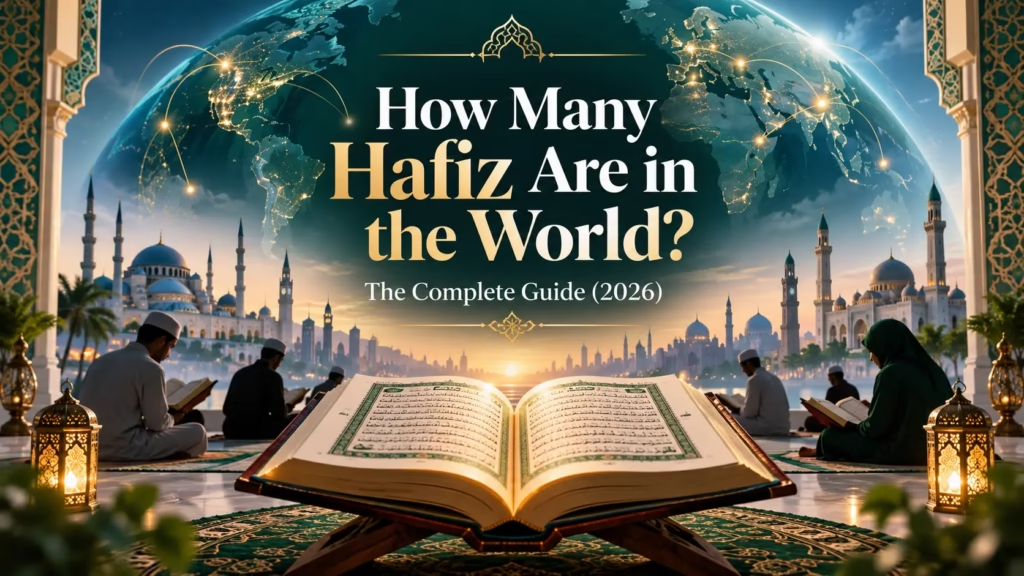
Millions of Muslims around the world devote years to memorizing the Holy Quran. From traditional madrasas in Pakistan to Quranic schools in Saudi Arabia, this remarkable tradition continues across generations.
But how many Hafiz are in the world today? Is there an official count, and which countries have the largest communities of Quran memorizers?
The answer isn’t as straightforward as you might expect. While Islamic educational institutions maintain extensive records of their students, no single organization tracks every Hafiz worldwide.
However, recent institutional statistics provide valuable insight into the number of people who have memorized the Quran and the continuing growth of Quranic education.
This guide examines verified figures, regional trends, and the process of becoming a Hafiz.
How Many Hafiz Are in the World in 2026?
As of 2026, there is no verified global count of living Huffaz (people who have memorized the entire Quran). Nevertheless, available educational records confirm that large numbers of Muslims have completed Quran memorization programs.
For example, Pakistan’s Wifaq ul Madaris Al Arabia reports nearly 1.96 million male and female Quran memorizers in its cumulative institutional statistics through 2026.
Wifaq ul Madaris Al Arabia Pakistan
This figure comes from one major educational network, not a worldwide census.
Meanwhile, Saudi Arabia’s official news agency reported that 8,335 male and female students completed Quran memorization through study circles at the Prophet’s Mosque during 2025.
Saudi Press Agency
These figures reveal the remarkable scale of Quranic education. However, they cannot establish how many living Huffaz exist across every country.
Key Facts About Quran Memorizers Worldwide
| Category | Verified information |
|---|---|
| Worldwide Hafiz population | No confirmed global total |
| Global Muslim population | Approximately 2 billion in 2020 |
| Pakistan Wifaq ul Madaris cumulative male Huffaz | 1,567,711 through 2026 |
| Pakistan Wifaq ul Madaris cumulative female Huffaz | 387,956 through 2026 |
| Combined Wifaq institutional total | 1,955,667 |
| Prophet’s Mosque memorization completions in 2025 | 8,335 students |
| Chapters in the Quran | 114 |
| Traditional Quran divisions | 30 juz |
The worldwide Muslim population estimate comes from Pew Research Center’s June 2025 report, which analyzed demographic data covering 2020.
Pew Research Center
Important distinction: Cumulative educational totals include historical completions. They shouldn’t be confused with the number of living memorizers in 2026.
Who Is Called a Hafiz in Islam?
A Hafiz is someone who has memorized the entire Holy Quran in Arabic.
The Arabic word Hafiz comes from a root associated with preserving, protecting, and remembering.
In Quranic education, the title recognizes someone who has committed the complete scripture to memory.
A female Quran memorizer is commonly called a Hafiza, while the Arabic plural Huffaz refers to Quran memorizers collectively.
Hafiz, Hafiza, and Huffaz: What’s the Difference?
| Term | Meaning |
|---|---|
| Hafiz | A person who has memorized the Quran, commonly referring to a male |
| Hafiza | A female Quran memorizer |
| Huffaz | Plural term for Quran memorizers |
| Hifz | The practice of memorizing the Quran |
| Murajaah | Reviewing previously memorized Quranic passages |
| Tajweed | Rules governing correct Quranic recitation |
Memorizing the Quran requires more than recognizing verses.
Students learn the Arabic text, practice pronunciation, and repeatedly revise earlier lessons to strengthen long-term retention.
Importantly, becoming a Hafiz doesn’t automatically make someone an Islamic scholar. Quran memorization and advanced religious scholarship are related but distinct areas of study.
Which Countries Have the Most Huffaz?
Quran memorization takes place throughout the Muslim world, particularly in countries with established Islamic educational networks.
However, there isn’t enough comparable national data to rank countries reliably by their total number of living Huffaz.
Several countries stand out because of their extensive Quranic educational traditions.
Pakistan: A Major Center of Quran Memorization
Pakistan has a large network of madrasas, mosques, and Quran memorization institutions.
One of its major educational organizations, Wifaq ul Madaris Al Arabia, publishes cumulative statistics for Quran memorizers and religious students.
According to its published performance figures through 1447 AH (2026), the organization reports:
Male Huffaz
1,567,711
Female Huffaz
387,956
Combined cumulative total
1,955,667
Source: Wifaq ul Madaris Al Arabia, institutional performance statistics through 2026.
Wifaq ul Madaris Al Arabia Pakistan
These records demonstrate substantial Quran memorization activity within one Pakistani educational network.
Still, they don’t represent a complete national census. Other institutions operate independently and the cumulative figures include graduates from earlier decades.
Saudi Arabia: Quran Education in Makkah and Madinah
Saudi Arabia hosts numerous Quran memorization programs, including study circles at major mosques.
The Prophet’s Mosque in Madinah provides a particularly well-documented example.
According to the Saudi Press Agency, 8,335 students completed Quran memorization through its study circles during 2025.
The same report states that more than 200,000 new male and female students joined those circles during the year. That larger enrollment figure covers Quranic educational programs broadly and shouldn’t be mistaken for the number of new Huffaz.
Saudi Press Agency
These programs serve students from different backgrounds and contribute to the international tradition of Quranic learning.
Indonesia and Bangladesh
Indonesia and Bangladesh also have significant traditions of Quranic education.
Both countries support Quran memorization through religious schools, residential institutions, mosques, and community programs.
In Indonesia, Islamic boarding schools known as pesantren play an important role in religious education.
Bangladesh likewise has extensive madrasa and Quran-learning networks.
However, without comprehensive national registers, assigning either country a precise Hafiz population would be misleading.
India and Other Countries
India has a longstanding tradition of Quran memorization through madrasas and local Islamic institutions.
Quran memorization also takes place across Egypt, Turkey, Morocco, Nigeria, Malaysia, and many other countries.
Muslim communities in the United States, United Kingdom, Canada, and Europe maintain hifz classes through mosques and Islamic schools.
The tradition isn’t limited to Muslim-majority nations.
Why Is There No Exact Worldwide Hafiz Count?
Counting the world’s Quran memorizers involves several challenges.
Unlike national population censuses, Quran memorization records often remain within individual schools and religious organizations.
Three major obstacles prevent a dependable global total.
Different Institutions Maintain Separate Records
Traditional madrasas, private tutors, mosques, and online Quran academies frequently manage their own student records.
No universally adopted reporting system combines their results.
Not Every Hafiz Receives the Same Certification
Some students complete formal examinations and receive certificates.
Others memorize the Quran under individual teachers or through family-based instruction.
Both paths can produce accomplished memorizers, although their achievements may not appear in the same databases.
Historical Graduates Aren’t the Same as Living Huffaz
A school’s cumulative graduate total includes people who completed memorization over many years.
Some may have died while others may have moved abroad.
Consequently, adding institutional graduate numbers doesn’t automatically reveal the current global Hafiz population.
How Long Does It Take to Become a Hafiz?
Memorizing the entire Quran is a substantial educational commitment.
The time required depends on a student’s age, available study hours, previous Arabic knowledge, memorization pace, and revision habits.
A 2026 guide by the Virtual Islamic Academy describes three to five years as a realistic period for many learners following five classes weekly alongside daily revision.
Virtual Islamic Academy
Some dedicated students finish sooner while others require additional years.
Quran Memorization: Important Figures
| Feature | Details |
|---|---|
| Total surahs | 114 |
| Traditional divisions | 30 juz |
| Pages in a common Madani Mushaf | 604 |
| Common study approach | New memorization alongside daily revision |
| Typical commitment | Often several years |
| Essential long-term practice | Regular revision |
The 604-page count refers to a widely used printed layout. Other editions may arrange the text differently.
The Main Stages of Hifz
- Learning correct recitation: Students develop their pronunciation and knowledge of tajweed.
- Memorizing new passages: They learn verses or pages according to a structured schedule.
- Revising previous lessons: Students regularly repeat older portions to prevent forgetting.
- Completing the Quran: They finish memorizing all 30 juz.
- Testing and continued revision: Many institutions conduct examinations while graduates continue reviewing their memorization.
A crucial lesson of hifz is that finishing the Quran isn’t the end of the process.
Maintaining memorization requires ongoing effort.
Why Is Becoming a Hafiz Important in Islam?
Muslims place great religious and cultural value on memorizing the Quran.
The practice strengthens a person’s connection with the scripture and supports its oral transmission.
One frequently cited hadith states:
“The best among you are those who learn the Quran and teach it.”
— Sahih al-Bukhari, Hadith 5027
For many families, a child’s completion of hifz represents a meaningful educational and spiritual achievement.
Beyond religious importance, Quran memorization can develop disciplined study habits, sustained attention, and familiarity with Arabic recitation.
However, the title Hafiz doesn’t guarantee expertise in Quranic interpretation, Islamic law, or Arabic linguistics. Those subjects require additional study.
How Has Technology Changed Quran Memorization?
Traditional instruction remains important but digital learning has expanded the ways students practice hifz.
Online academies now connect teachers and students across national borders.
Many learners also use audio recordings, repetition tools, and digital progress trackers.
These resources can support students who cannot attend a full-time madrasa.
For example, an adult working full-time may schedule remote recitation lessons and use a mobile app for daily revision.
However, digital access doesn’t automatically guarantee memorization quality.
Qualified instruction, correct pronunciation, and consistent review remain important regardless of the learning platform.
Frequently Asked Questions
Q1: How Many Hafiz Are in the World Today?
No authoritative organization has published a verified worldwide count for 2026. Institutional records document large numbers of Quran memorizers, including nearly 1.96 million cumulative completions within Pakistan’s Wifaq ul Madaris network alone. However, that figure isn’t a count of currently living Huffaz.
Q2: Which Country Has the Most Hafiz?
No reliable global ranking identifies the country with the highest number of living Quran memorizers. Pakistan has particularly extensive documented institutional records but those figures don’t establish its position against every other country.
Q3: How Many Female Hafiz Are There?
There is no verified worldwide total for female Quran memorizers. Pakistan’s Wifaq ul Madaris reports 387,956 female Huffaz in its cumulative statistics through 2026. This figure represents one institution’s historical records rather than all living female memorizers worldwide.
Q4: Can a Woman Become a Hafiz?
Yes. Women can memorize the entire Quran and commonly receive the title Hafiza. Female students participate in Quran memorization programs across Muslim communities worldwide.
Q5: Can Someone Become a Hafiz Without Knowing Arabic?
Yes. A person can memorize the Quran’s Arabic text without speaking Arabic fluently. However, learning proper pronunciation and understanding the verses can improve the educational experience.
Q6: How Many Years Does It Take to Memorize the Quran?
Many students require approximately three to five years under a structured learning schedule. Actual completion times vary significantly according to daily study hours, memory retention, previous preparation, and revision.
Q7: Does a Hafiz Have to Memorize All 30 Juz?
Yes. In its usual Quranic educational meaning, the title Hafiz refers to someone who has memorized the complete Quran, consisting of 30 juz. Memorizing only selected chapters doesn’t generally qualify someone for that title.
Q8: Are There Huffaz in the United States?
Yes. Muslim communities across the United States operate Quran memorization programs through mosques, Islamic schools, and private institutions. However, a comprehensive national total isn’t available.
Conclusion
The question of how many Hafiz exist worldwide highlights an extraordinary tradition of learning and preservation.
Although no verified global total exists for 2026, institutional records demonstrate the substantial reach of Quran memorization education.
Pakistan’s Wifaq ul Madaris reports nearly 1.96 million cumulative male and female Quran memorizers through 2026. Meanwhile, the Prophet’s Mosque in Madinah recorded 8,335 memorization completions during 2025.
These figures provide measurable evidence of the tradition’s scale without pretending to represent a worldwide census.
Ultimately, the importance of hifz extends beyond statistics. Every student who memorizes and continues reviewing the Quran contributes to a tradition that Muslims have maintained for centuries.