
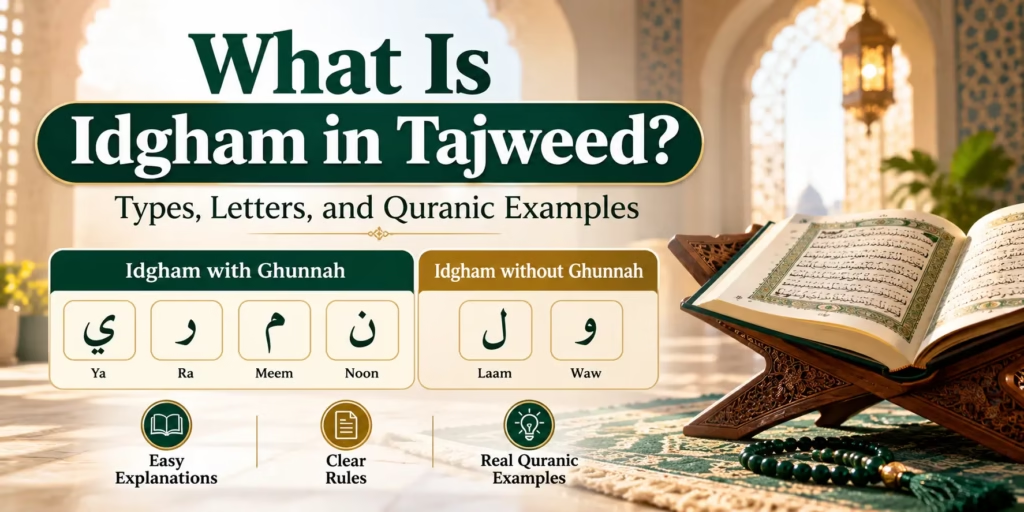
Have you ever listened to a skilled Quran reciter and noticed how some Arabic letters blend smoothly into the next? Instead of pronouncing every letter separately, the reciter joins certain sounds without losing the beauty or accuracy of the words. This is where Idgham in Tajweed comes in.
Idgham (إدغام) means merging or combining two letters into one strengthened sound. It is an essential Tajweed rule that helps Muslims recite the Holy Quran correctly and fluently.
For example, when Noon Sakinah (نْ) comes before certain Arabic letters, you don’t pronounce the Noon separately. Instead, its sound merges into the following letter. Depending on the letter, you may also produce a gentle nasal sound called Ghunnah.
Sounds complicated? It’s easier than you might think.
In this guide, you’ll learn the six Idgham letters, the difference between its two main types, authentic Quranic examples, important exceptions, and practical pronunciation techniques.
What Is Idgham in Tajweed?
The Arabic word Idgham (الإدغام) literally means to insert or to merge something into something else.
In Tajweed, Idgham occurs when one letter merges into the letter immediately following it. The resulting pronunciation treats the two letters as a single strengthened letter.
Consider the expression:
مِنْ رَبِّهِمْ
Min Rabbihim — From their Lord
When reciting these words together, the Noon Sakinah in مِنْ merges into the following letter Ra (ر).
Instead of clearly pronouncing a separate “n” sound, you move directly into the strengthened Ra.
This creates a smooth transition between the words.
Why Is Idgham Important in Quran Recitation?
Allah says in Surah Al-Muzzammil (73:4):
وَرَتِّلِ الْقُرْآنَ تَرْتِيلًا
“And recite the Quran with measured recitation.”
Tajweed helps Muslims put this instruction into practice by observing the correct pronunciation and characteristics of Arabic letters.
Learning Idgham helps you:
- Improve pronunciation: Merge letters correctly rather than separating sounds that should join.
- Develop smoother recitation: Move naturally between connected Quranic words.
- Apply Ghunnah accurately: Recognize when a nasal sound is necessary.
- Avoid common Tajweed mistakes: Distinguish merging from clear pronunciation and concealment.
- Build confidence: Identify rules while reading the Mushaf instead of guessing.
Understanding the rule is a valuable first step. However, listening to a qualified teacher and practicing the correct sound are equally important.
You can develop these skills through structured online Tajweed courses that combine clear explanations with live pronunciation correction.
What Are the Six Letters of Idgham?
There are six Idgham letters in the rules of Noon Sakinah and Tanween.
They are:
The Six Idgham Letters
ي
ر
م
ل
و
ن
يَرْمَلُونَ
Yarmaloon — the traditional memory word for all six letters
ي ن م و
With GhunnahFour letters · nasal merging
ل ر
Without GhunnahTwo letters · no nasal merging
Students commonly memorize these letters through the Arabic word Yarmaloon (يرملون).
The six letters fall into two main groups.
| Type of Idgham | Arabic Name | Letters | Ghunnah |
|---|---|---|---|
| Idgham with Ghunnah | إدغام بغنة | ي، ن، م، و | Yes, two counts |
| Idgham without Ghunnah | إدغام بلا غنة | ل، ر | No |
Important: These rules apply when Noon Sakinah or Tanween meets an Idgham letter at the beginning of the following word during connected recitation.
There are also specific exceptions, which we’ll explain below.
What Are Noon Sakinah and Tanween?
Before exploring the different types of Idgham, you should understand two important Tajweed terms.
Noon Sakinah (نْ)
Noon Sakinah is the Arabic letter Noon (ن) carrying Sukoon (ْ), meaning it has no short vowel.
For example:
مِنْ — Min
The Noon carries Sukoon.
When another word follows, the first letter of that word determines which Tajweed rule applies.
Tanween (تنوين)
Tanween refers to the doubled vowel marks that produce an additional “n” sound in pronunciation.
There are three forms:
| Tanween | Arabic Name | Example |
|---|---|---|
| ـً | Fathatain | كِتَابًا |
| ـٍ | Kasratain | كِتَابٍ |
| ـٌ | Dammatain | كِتَابٌ |
For example, كِتَابٌ is pronounced kitābun when its Tanween ending is fully articulated.
When Tanween meets an Idgham letter in the next word, the final Noon sound merges according to the applicable rule.
However, remember that Tanween pronunciation can change when you stop at the end of a word.
Types of Idgham in Tajweed
For Noon Sakinah and Tanween, the two primary types are Idgham with Ghunnah and Idgham without Ghunnah.
The main difference is whether you maintain a nasal resonance during the merge.
Idgham with Ghunnah (إدغام بغنة)
Idgham with Ghunnah occurs when Noon Sakinah or Tanween is followed by one of these four letters:
ي — ن — م — و
You can remember them using the word يَنْمُو (Yanmu).
When this rule applies, the Noon sound merges into the next letter while you maintain Ghunnah for approximately two counts.
What Is Ghunnah?
Ghunnah (غنة) is a nasal resonance produced through the nasal passage.
You hear it most clearly in certain pronunciations of Noon (ن) and Meem (م).
Imagine gently humming with your mouth positioned for the following letter. This gives you a basic idea of nasal resonance, although correct Tajweed requires more precise articulation.
A qualified teacher can help you produce Ghunnah without exaggerating or shortening it.
Quranic Examples of Idgham with Ghunnah
Here are four authentic examples, one for each letter.
| Letter | Quranic Example | Reference | Explanation |
|---|---|---|---|
| ي (Ya) | فَمَن يَعْمَلْ | Az-Zalzalah 99:7 | Noon merges into Ya with Ghunnah. |
| ن (Noon) | مِن نِّعْمَةٍ | An-Nahl 16:53 | Noon merges into the following Noon. |
| م (Meem) | مِن مَّاءٍ | Al-Mursalat 77:20 | Noon merges into Meem with Ghunnah. |
| و (Waw) | خَيْرٌ وَأَبْقَىٰ | Al-A’la 87:17 | Tanween merges into Waw with Ghunnah. |
Let’s examine two examples more closely.
Example: فَمَن يَعْمَلْ — Surah Az-Zalzalah 99:7
The Quran says:
فَمَن يَعْمَلْ مِثْقَالَ ذَرَّةٍ خَيْرًا يَرَهُ
“So whoever does an atom’s weight of good will see it.”
The Noon Sakinah in مَن comes before Ya (ي) in يَعْمَلْ.
Because Ya belongs to the four Ghunnah letters, you merge the Noon sound while maintaining nasal resonance for two counts.
The same verse also contains Idgham with Ghunnah in خَيْرًا يَرَهُ, where Tanween meets Ya.
Example: مِن مَّاءٍ — Surah Al-Mursalat 77:20
The Quran says:
أَلَمْ نَخْلُقكُّم مِّن مَّاءٍ مَّهِينٍ
“Did We not create you from a humble fluid?”
Here, Noon Sakinah in مِن comes before Meem (م) in مَاءٍ.
The Noon merges into Meem with a nasal sound.
Pronunciation tip: Keep your lips together for the Meem and maintain Ghunnah for two counts without producing a separate Noon first.
This is an excellent example for practicing the connection between two words.
Idgham without Ghunnah (إدغام بلا غنة)
Idgham without Ghunnah occurs when Noon Sakinah or Tanween comes before either of these letters:
ل (Lam) or ر (Ra)
Unlike the previous type, this rule requires a direct merge without retaining the Noon’s nasal resonance.
The reciter moves smoothly into the following Lam or Ra.
Quranic Examples of Idgham without Ghunnah
| Letter | Quranic Example | Reference | Explanation |
|---|---|---|---|
| ل (Lam) | هُدًى لِّلْمُتَّقِينَ | Al-Baqarah 2:2 | Tanween merges into Lam. |
| ر (Ra) | مِن رَّبِّهِمْ | Al-Baqarah 2:5 | Noon merges into Ra. |
| ل (Lam) | مِن لَّدُنْهُ | Al-Kahf 18:2 | Noon merges into Lam. |
Example: مِن رَّبِّهِمْ — Surah Al-Baqarah 2:5
The phrase مِن رَّبِّهِمْ means “from their Lord.”
Here, Noon Sakinah meets Ra.
Instead of clearly pronouncing the Noon, merge directly into the strengthened Ra.
Don’t hold a nasal hum before the Ra. That would incorrectly introduce Ghunnah where this rule doesn’t require it.
Example: هُدًى لِّلْمُتَّقِينَ — Surah Al-Baqarah 2:2
This expression means “guidance for the God-conscious.”
The Tanween on هُدًى meets Lam in لِّلْمُتَّقِينَ.
The Tanween’s Noon sound merges into Lam without Ghunnah.
Key reminder: Lam and Ra are always the two letters to remember for Idgham without Ghunnah in the Noon Sakinah and Tanween rules.
Idgham with Ghunnah vs. Without Ghunnah
Understanding both types side by side makes the difference much clearer.
| Feature | With Ghunnah | Without Ghunnah |
|---|---|---|
| Letters | ي، ن، م، و | ل، ر |
| Nasal resonance | Present | Not retained |
| Ghunnah duration | Two counts | No Ghunnah hold |
| Noon pronunciation | Merges into next letter | Merges into next letter |
| Example | مِن مَّاءٍ | مِن رَّبِّهِمْ |
| Common mistake | Skipping or shortening Ghunnah | Adding unnecessary Ghunnah |
Both types involve merging. The distinguishing feature is the nasal resonance.
Important Exception: When Idgham Does Not Apply
Here’s a rule that many beginners overlook.
When Noon Sakinah and an Idgham letter occur inside the same word, you don’t apply the usual Idgham rule.
Instead, you pronounce the Noon clearly. Tajweed scholars call this Izhar Mutlaq (إظهار مطلق), meaning absolute or unconditional clarity.
In the commonly taught Hafs recitation, four Quranic words illustrate this exception:
| Quranic Word | Meaning | Quranic Reference |
|---|---|---|
| دُنْيَا | Worldly life | Al-Baqarah 2:85 |
| بُنْيَان | Structure or building | As-Saff 61:4 |
| صِنْوَان | Palm trees sharing a root | Ar-Ra’d 13:4 |
| قِنْوَان | Clusters of dates | Al-An’am 6:99 |
Take the word دُنْيَا (Dunya).
The Noon Sakinah appears before Ya within the same word.
Even though Ya is an Idgham letter, you must pronounce the Noon clearly.
Don’t merge the two sounds.
The same principle applies to the other three words.
This exception highlights why understanding Tajweed involves more than memorizing letters. You also need to recognize how letters appear within words and across word boundaries.
What Is Idgham Shafawi?
Idgham isn’t limited to Noon Sakinah and Tanween.
Another important form is Idgham Shafawi (إدغام شفوي), which applies to Meem Sakinah (مْ).
It occurs when a Meem carrying Sukoon comes immediately before another Meem carrying a vowel.
The two Meems merge into one strengthened Meem with Ghunnah for two counts.
Quranic Example of Idgham Shafawi
Surah Al-Baqarah (2:141) contains:
وَلَكُم مَّا كَسَبْتُمْ
“And for you is what you have earned.”
The Meem at the end of لَكُمْ meets the Meem at the beginning of مَّا.
During connected recitation, the two sounds merge with nasal resonance.
Because Meem is articulated using the lips, this rule is called Shafawi, meaning related to the lips.
Another example appears in Surah Quraysh (106:4):
وَآمَنَهُم مِّنْ خَوْفٍ
Here, the final Meem of هُم merges into the following Meem.
Other Categories of Idgham in Tajweed
As students progress, they encounter additional ways to classify merging rules.
These classifications focus on the relationship between the letters.
| Category | Arabic Name | Explanation |
|---|---|---|
| Idgham Mutamathilayn | إدغام المتماثلين | Merging two identical letters |
| Idgham Mutajanisayn | إدغام المتجانسين | Merging certain letters that share an articulation point |
| Idgham Mutaqaribayn | إدغام المتقاربين | Merging certain letters with nearby articulation points or related characteristics |
| Idgham Kamil | إدغام كامل | Complete merging of the first letter into the next |
| Idgham Naqis | إدغام ناقص | Incomplete merging in which a characteristic of the first letter remains |
For example, in قُل لَّا أَسْأَلُكُمْ, two Lam sounds meet and merge. This illustrates Idgham Mutamathilayn.
These advanced classifications have their own conditions and exceptions. Their exact applications can also depend on the accepted recitation tradition.
Beginners should first master the six Idgham letters and the distinction between Ghunnah and no Ghunnah.
Once those rules become familiar, the additional categories are easier to understand.
How to Pronounce Idgham Correctly: Step-by-Step
Recognizing Idgham on a Quranic page is one skill. Producing the sound correctly is another.
Use this practical method when studying.
- Find Noon Sakinah or Tanween.Look for نْ or one of the doubled vowel marks: ـً، ـٍ، ـٌ.
- Examine the next letter.Check whether the following word begins with one of the six Idgham letters: ي، ر، م، ل، و، ن.
- Identify the correct type.If the following letter is ي، ن، م، or و, apply Ghunnah. If it’s ل or ر, merge without Ghunnah.
- Merge the sounds naturally.Don’t pronounce the Noon separately before merging. Move smoothly into the following letter.
- Apply the correct nasal duration.Maintain approximately two counts for Ghunnah when required. Avoid nasalizing Lam or Ra under the rule of Idgham without Ghunnah.
- Listen, repeat, and correct.Practice with an accurate Quran recitation and ask a qualified Tajweed teacher to check your pronunciation.
Does Idgham Apply When You Stop Reading?
This is an important detail.
The ordinary Idgham rules of Noon Sakinah and Tanween require you to connect the relevant words during recitation.
If you stop at the first word, the following letter no longer joins it in the same way.
For example, when connecting مِنْ رَبِّهِمْ, you apply Idgham without Ghunnah.
But if you stop at مِنْ, you pronounce its final Noon according to the stopping position rather than merging it into Ra.
Recognizing the difference between Waqf (stopping) and Wasl (continuing) prevents many recitation errors.
Common Idgham Mistakes and How to Avoid Them
Even students who remember all six letters sometimes struggle with pronunciation.
Here are common mistakes and practical solutions.
| Common Mistake | Why It’s Incorrect | How to Fix It |
|---|---|---|
| Pronouncing Noon separately | Prevents proper merging | Move directly into the following letter |
| Skipping Ghunnah | Removes the required nasal resonance | Practice the two-count sound |
| Adding Ghunnah before Lam or Ra | Applies the wrong Idgham type | Merge directly without a nasal hold |
| Holding Ghunnah too long | Disturbs the correct duration | Practice steady two-count timing |
| Applying Idgham within دُنْيَا | Ignores Izhar Mutlaq | Pronounce Noon clearly |
| Applying the rule across a stop | Confuses connected and stopped recitation | Identify whether you’re continuing |
Practice With Short Quranic Phrases
Instead of attempting a long passage immediately, practice these four expressions:
- فَمَن يَعْمَلْ — Idgham with Ghunnah before Ya.
- مِن مَّاءٍ — Idgham with Ghunnah before Meem.
- مِن رَّبِّهِمْ — Idgham without Ghunnah before Ra.
- هُدًى لِّلْمُتَّقِينَ — Idgham without Ghunnah before Lam.
Read each expression slowly. Then connect the words at a natural recitation pace.
Focus on accuracy rather than speed.
Idgham vs. Izhar, Ikhfa, and Iqlab
Idgham belongs to a larger group of Tajweed rules involving Noon Sakinah and Tanween.
There are four main rules in this group.
| Tajweed Rule | Arabic | Main Function | Letters |
|---|---|---|---|
| Izhar | إظهار | Pronounce clearly | ء، ه، ع، ح، غ، خ |
| Idgham | إدغام | Merge into the next letter | ي، ر، م، ل، و، ن |
| Iqlab | إقلاب | Change the Noon sound into a concealed Meem sound | ب |
| Ikhfa | إخفاء | Conceal the Noon sound with Ghunnah | 15 remaining letters |
The distinction becomes easier when you think about what happens to the original Noon sound.
Izhar: You pronounce it clearly.
Idgham: You merge it into the next letter.
Iqlab: You change it into a concealed Meem sound.
Ikhfa: You conceal it without fully merging it.
Learning these four rules together gives you a stronger understanding of Quranic pronunciation.
How to Teach Idgham to Beginners and Children
Children and new learners often understand Tajweed more easily when teachers combine visual examples with short pronunciation exercises.
A useful approach involves three stages.
Start With the Arabic Letters
First, learners should recognize Noon, Meem, Ya, Waw, Lam, and Ra.
They should also understand Sukoon, Tanween, and Shaddah.
If you’re starting from the Arabic alphabet, the Noorani Qaida course for kids and adults provides a structured foundation in letter recognition, pronunciation, and basic Tajweed.
Teach the Two Idgham Groups Separately
Introduce the four Ghunnah letters first:
ي ن م و
Let students practice each letter with a short Quranic expression.
Afterward, introduce Lam and Ra as the two letters without Ghunnah.
This separation helps learners remember the difference without becoming overwhelmed.
Use Listening and Repetition
A short, focused exercise can be more helpful than memorizing several pages of definitions.
For example:
- Listen to the teacher recite مِن مَّاءٍ.
- Repeat the expression slowly.
- Identify the Ghunnah sound.
- Listen to مِن رَّبِّهِمْ.
- Notice the absence of a nasal hold.
- Repeat both expressions and compare them.
This method connects the written rule with its actual sound.
For students who already read Arabic confidently, online Quran memorization classes can also reinforce correct recitation through repeated reading and revision.
Learn Idgham and Other Tajweed Rules With Online Quran Pakistan
Reading about Tajweed gives you valuable knowledge. However, proper recitation requires listening, practice, and individual feedback.
At Online Quran Pakistan, students can learn Quran recitation through live, one-on-one lessons with qualified teachers.
The academy offers flexible online classes for children, adults, and beginners worldwide.
Through its online Tajweed course, students can work on:
- Correct Arabic letter pronunciation and Makharij
- Noon Sakinah and Tanween rules
- Idgham, Izhar, Ikhfa, and Iqlab
- Ghunnah and nasal pronunciation
- Meem Sakinah rules
- Quranic recitation fluency
- Practical mistakes and individual correction
Whether you’re learning Idgham for the first time or improving your existing recitation, personalized lessons can help you recognize and apply the rules more confidently.
Ready to improve your Quran recitation? Book a free trial class with Online Quran Pakistan and experience guided Tajweed learning.
Frequently Asked Questions About Idgham in Tajweed
What Does Idgham Mean in Tajweed?
Idgham means merging or assimilation. It occurs when one Arabic letter combines with the following letter during Quranic recitation. In the rules of Noon Sakinah and Tanween, six specific letters trigger Idgham.
How Many Idgham Letters Are There?
There are six Idgham letters for Noon Sakinah and Tanween: ي، ر، م، ل، و، ن. Students memorize them through the Arabic word يَرْمَلُون (Yarmaloon).
What Are the Two Main Types of Idgham?
The two main types are Idgham with Ghunnah and Idgham without Ghunnah. The first uses four letters and requires a two-count nasal resonance. The second uses Lam and Ra without retaining Ghunnah.
What Are the Four Letters of Idgham with Ghunnah?
The letters are ي، ن، م، و. They form the memory word يَنْمُو (Yanmu). When Noon Sakinah or Tanween meets one of these letters across two connected words, the sound merges with Ghunnah.
What Is Idgham without Ghunnah?
Idgham without Ghunnah occurs when Noon Sakinah or Tanween is followed by Lam (ل) or Ra (ر). The Noon sound merges into the following letter without a nasal hold.
What Is the Difference Between Idgham and Ikhfa?
Idgham merges the Noon sound into the next letter. Ikhfa conceals the Noon sound while maintaining Ghunnah. The two rules use different sets of letters and different pronunciation techniques.
What Is Idgham Shafawi?
Idgham Shafawi occurs when Meem Sakinah (مْ) meets another Meem carrying a vowel. The two Meems merge into one strengthened Meem with Ghunnah for two counts.
Can Idgham Occur Within the Same Word?
The normal Noon Sakinah Idgham rule doesn’t apply when Noon Sakinah and the relevant Idgham letter occur inside the same word. Words such as دُنْيَا and بُنْيَان follow Izhar Mutlaq, meaning the Noon remains clearly pronounced.
How Can Beginners Learn Idgham Easily?
Begin by memorizing the six letters. Next, separate the four Ghunnah letters from Lam and Ra. Practice short Quranic phrases, listen to accurate recitations, and receive pronunciation correction from a qualified Tajweed teacher.
Conclusion: Master Idgham for Better Quran Recitation
Idgham is one of the essential rules of Tajweed. It teaches you when to merge Arabic sounds while reciting the Holy Quran.
The most important points are simple:
- Six letters: ي، ر، م، ل، و، ن
- With Ghunnah: ي، ن، م، و
- Without Ghunnah: ل، ر
- Ghunnah duration: Two counts when required
- Important exception: Four Quranic words follow Izhar Mutlaq instead of the usual Noon Sakinah Idgham.
Don’t rush to memorize every advanced classification at once. Start with the main letters, practice authentic Quranic examples, and gradually develop your pronunciation.
With consistent practice and proper guidance, you’ll begin recognizing Idgham naturally while reciting.
And if you’d like a teacher to help you correct your Tajweed, explore the Quran learning courses at Online Quran Pakistan and take the next step toward more accurate, confident recitation.