
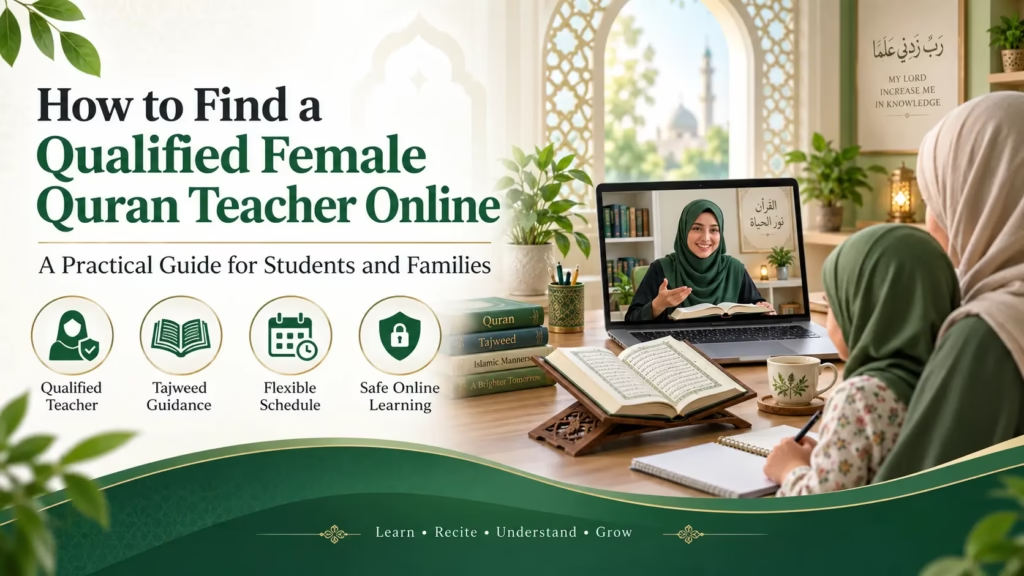
Learning the Quran is a deeply personal journey, and choosing the right teacher can make a major difference in a student’s confidence, pronunciation, understanding, and consistency. For many women, girls, and families, finding a qualified female Quran teacher online is especially important because it provides a comfortable learning environment while making Quran education accessible from home.
The challenge is that there are now hundreds of teachers and online Quran academies offering lessons. A professional-looking profile or a claim of having years of experience does not always tell you whether a teacher is actually suitable for you or your child.
A good female Quran teacher should have sound Quranic knowledge, strong recitation skills, patience, teaching ability, and an approach that matches the student’s level. This guide explains what to look for, what questions to ask, and how to evaluate a teacher before committing to regular classes.
Start With Your Learning Goal
Before looking for a teacher, identify exactly what you or your child wants to learn.
A complete beginner may need to begin with Arabic letters and Noorani Qaida. Someone who can already read the Quran may need help with fluency, Makharij, and Tajweed. Another learner may be interested in Hifz, Quran translation, Tafseer, Islamic Studies, or improving Salah and daily duas.
The right teacher for one course may not necessarily be the best teacher for another.
For example, a teacher who is excellent at teaching young beginners may specialize in Qaida and Quran reading, while an advanced student may require someone with deeper Tajweed or Qiraat training.
Knowing your goal helps you search for the right expertise instead of simply choosing the first available teacher.
Check Her Quranic Qualifications
The first thing to evaluate is the teacher’s educational background.
A qualified female Quran teacher should have received proper training in the subjects she teaches. If she is teaching Tajweed, she should understand both the rules and their practical application. If she is teaching Hifz, she should know how to manage new memorization, daily revision, and older portions.
Do not hesitate to ask about qualifications.
Some teachers may have completed Hifz-ul-Quran, Tajweed certification, Islamic Studies, Arabic studies, Dars-e-Nizami, or an Ijazah in Quran recitation. The exact qualification needed depends on the course.
Qualifications alone, however, are not enough.
A teacher may possess excellent Islamic knowledge but still struggle to explain lessons clearly to beginners. That is why teaching ability should be evaluated separately.
Look for Strong Tajweed and Pronunciation
Correct pronunciation is one of the most important elements of Quran learning.
Arabic contains sounds that may be unfamiliar to students who speak English, Urdu, Hindi, or other languages. Without proper guidance, beginners can develop pronunciation habits that become difficult to correct later.
A skilled teacher should be able to hear subtle mistakes, explain the correct articulation point, demonstrate the sound, and ask the student to repeat it until improvement is achieved.
During a trial lesson, pay attention to how carefully the teacher listens.
Does she correct mistakes immediately?
Does she explain why a pronunciation is incorrect?
Can she demonstrate difficult letters clearly?
A good teacher does not simply ask the student to keep reading. She actively improves the student’s recitation.
Teaching Skills Matter as Much as Knowledge
Knowing the Quran and teaching the Quran are related, but they are not the same skill.
Teaching requires patience, communication, observation, and the ability to adapt lessons to individual learners.
This becomes especially important when teaching children.
Young students may become distracted, hesitate when reading, or need the same concept explained several times. A teacher who becomes frustrated easily may make a child nervous about Quran lessons.
A qualified female Quran teacher should create a respectful but encouraging learning environment.
She should know when to correct firmly, when to repeat an exercise, and when to encourage the student for progress.
For adult learners, good communication is equally important. Adults often feel embarrassed about starting Quran reading later in life. A supportive teacher can help remove that hesitation and make learning much more comfortable.
Choose a Teacher Experienced With Your Age Group
A teacher who works well with adults may not necessarily be ideal for a six-year-old child.
Similarly, a teacher who mainly teaches young beginners may not be the right choice for an advanced Tajweed student.
Ask about teaching experience with the student’s age group.
For children, the teacher should be able to keep lessons focused, use repetition effectively, and divide learning into manageable sections.
For teenagers, the teacher may need a balance between structure and encouragement.
For adults, lessons should respect the student’s pace while allowing enough time for detailed correction and questions.
The best teacher is not simply the person with the most years of experience. It is the person whose experience is relevant to the learner.
Check the Language of Instruction
Communication becomes much easier when the teacher can explain lessons in a language the student understands well.
Although Quran recitation itself is in Arabic, students may need explanations in English, Urdu, Hindi, Arabic, or another language.
This is particularly important for beginners.
A child who speaks mainly English may struggle if the teacher can recite beautifully but cannot explain basic instructions clearly.
Likewise, an adult may prefer Urdu or Hindi when learning Tajweed rules in detail.
Before enrolling, confirm which languages the teacher can comfortably use during lessons.
Take a Trial Class Before Enrolling
A trial lesson is one of the best ways to evaluate a Quran teacher.
It allows you to see her teaching style rather than relying only on qualifications or testimonials.
During the trial, observe how the teacher communicates, how carefully she listens, and whether the student feels comfortable.
A useful trial should also allow the teacher to assess the learner’s current level.
For example, she may ask the student to identify Arabic letters, read from Qaida, recite a short passage, or read several verses from the Quran.
Afterward, the teacher should ideally explain where the student should begin and what areas need improvement.
If possible, take more than one trial lesson before making a long-term decision. A single session may not always provide enough information.
Evaluate How She Corrects Mistakes
Mistake correction is one of the clearest signs of teaching quality.
A good Quran teacher does more than say, “That is wrong.”
She should show the correct pronunciation and help the student understand how to improve it.
The correction should also be appropriate for the learner’s age and confidence level.
Children should not feel humiliated when they make mistakes. Adults should not feel uncomfortable asking the same question again.
The goal is improvement, not embarrassment.
Good teachers are patient enough to repeat a sound or word several times when necessary.
Ask About the Lesson Structure
Professional Quran lessons should have some structure.
The student should generally know what is being studied, what was covered previously, and what should be practiced before the next class.
For beginners, this may include Qaida exercises, Arabic letter practice, short reading assignments, and repetition.
For Quran reading students, it may include a specific number of lines or pages.
For Tajweed learners, the teacher may introduce a rule and then help the student apply it during recitation.
For Hifz students, lessons often require a careful balance between new memorization and revision.
A structured approach makes progress easier to monitor.
Consider Online Class Safety and Privacy
Safety is particularly important when lessons involve children.
Parents should understand how classes are conducted and which platform is used.
Common options include Zoom, Google Meet, Microsoft Teams, and similar live-class platforms.
Parents may also want to know whether they can remain nearby during lessons, whether the teacher uses video, and how the academy handles teacher supervision.
A professional Quran learning provider should have clear communication channels and policies for both students and teachers.
Parents should always feel comfortable asking questions about who is teaching their child.
Look for Reliable Scheduling
Consistency is essential for Quran learning.
A highly qualified teacher may still be unsuitable if her schedule constantly conflicts with yours.
Before starting classes, confirm whether the teacher is regularly available at the required time.
Families living in different countries should pay particular attention to time zones.
Students in the USA, UK, Canada, Australia, Europe, the Middle East, and Asia may need very different class times.
A suitable schedule should fit naturally into school, work, family, and prayer routines.
It is usually better to choose a realistic timetable that can be maintained for months rather than an intensive schedule that becomes difficult after a few weeks.
Ask About Attendance and Makeup Policies
Even with careful planning, students or teachers may occasionally miss a class.
Before enrolling, ask what happens in these situations.
Does the academy offer a makeup class if the teacher is unavailable?
How early should students inform the teacher if they cannot attend?
Can classes be rescheduled when necessary?
Clear policies prevent misunderstandings later.
This is particularly important for families paying monthly fees for several classes per week.
Read Reviews Carefully
Reviews can help you understand the experience of other students, but the quality of the review matters more than the star rating alone.
Look for detailed comments about teaching, punctuality, communication, progress, and behavior with children.
A review explaining how a child’s Quran reading improved over several months provides more useful information than a short comment saying, “Excellent teacher.”
You should also remember that reviews are only one part of the decision.
A teacher who was perfect for one student may not necessarily be the right fit for another.
Make Sure Progress Is Monitored
Quran learning should involve measurable improvement.
That does not mean students must rush through lessons. Progress may be gradual, especially for beginners.
However, parents and students should have some idea of what is improving.
For example, a learner may begin recognizing Arabic letters more quickly, reading words with fewer pauses, pronouncing difficult letters more accurately, or applying Tajweed rules consistently.
For children, parents may benefit from occasional progress updates.
This allows them to understand what their child is learning and what should be revised at home.
Signs of a Good Female Quran Teacher
When comparing teachers, a useful checklist is:
- She has appropriate Quranic qualifications for the course she teaches.
- Her Quran recitation and Tajweed are strong.
- She corrects pronunciation carefully.
- She communicates clearly.
- She is patient with beginners and children.
- She has experience with the student’s age and level.
- She follows a structured lesson plan.
- She is punctual and dependable.
- She provides useful revision or homework.
- She makes the student feel comfortable asking questions.
- She respects Islamic manners and professional boundaries.
- She is available at a sustainable class time.
No single point should determine the entire decision, but together these qualities provide a strong indication of teaching quality.
Female Quran Teacher for Children
Parents searching for a female Quran teacher online for kids should pay particular attention to patience and communication.
Children usually respond better to lessons that are focused but not unnecessarily long.
The teacher should encourage them to participate actively instead of doing most of the reading herself.
Repetition is important, but lessons should not become monotonous.
A skilled teacher can maintain discipline while still making children feel comfortable and motivated.
Parents should also review lessons occasionally so they understand what their child is practicing.
Female Quran Teacher for Adults
Many adult women want to improve Quran reading but feel uncertain about where to start.
Some may have learned as children and forgotten much of what they studied. Others may never have had the opportunity to learn Arabic reading properly.
There should be no embarrassment in starting again.
A suitable female Quran teacher can assess the student’s current level and begin from the appropriate point.
Adults may benefit from lessons focusing on Quran fluency, Tajweed, Makharij, Quran translation, Tafseer, or Islamic Studies depending on their goals.
Online learning can be particularly helpful because classes can often be arranged around work and family commitments.
Do Not Choose Based on Price Alone
Cost naturally matters when choosing Quran classes, but it should not be the only consideration.
Very low fees may look attractive, but poor teaching can cost the learner much more time in the long run.
At the same time, an expensive teacher is not automatically better.
Compare teaching quality, qualifications, class duration, communication, reliability, and student support.
The best choice is a teacher who provides good value while allowing the student to continue learning consistently.
Where Can You Find a Female Quran Teacher Online?
Students can find teachers through online Quran academies, Islamic education platforms, local mosque recommendations, community groups, and referrals from other families.
Working through an established online Quran academy can offer additional advantages because the academy may already have a teacher selection process, multiple female teachers, administrative support, and the option to change teachers when necessary.
For example, families looking to learn Quran online can explore institutions such as International Quran Academy, where students can study courses including Noorani Qaida, Quran reading, Tajweed, Hifz, Quran Translation and Tafseer, Arabic, and Islamic Studies with male or female teachers.
A trial period can help families evaluate the teacher before deciding whether to continue regular classes.
Final Thoughts
Finding a qualified female Quran teacher online requires more than checking a profile or choosing the lowest fee.
Start by understanding the student’s learning goal. Then evaluate the teacher’s Quranic knowledge, Tajweed, communication skills, teaching experience, language ability, punctuality, and approach to correction.
Most importantly, experience the teaching yourself.
A trial class can quickly show whether the teacher and student are comfortable working together.
The right teacher should help the student improve gradually while developing confidence, consistency, and a stronger connection with the Quran.
When Quran learning is guided by a knowledgeable, patient, and dependable teacher, online classes can become a practical and meaningful way for women and children to continue their Quranic education from almost anywhere in the world.