
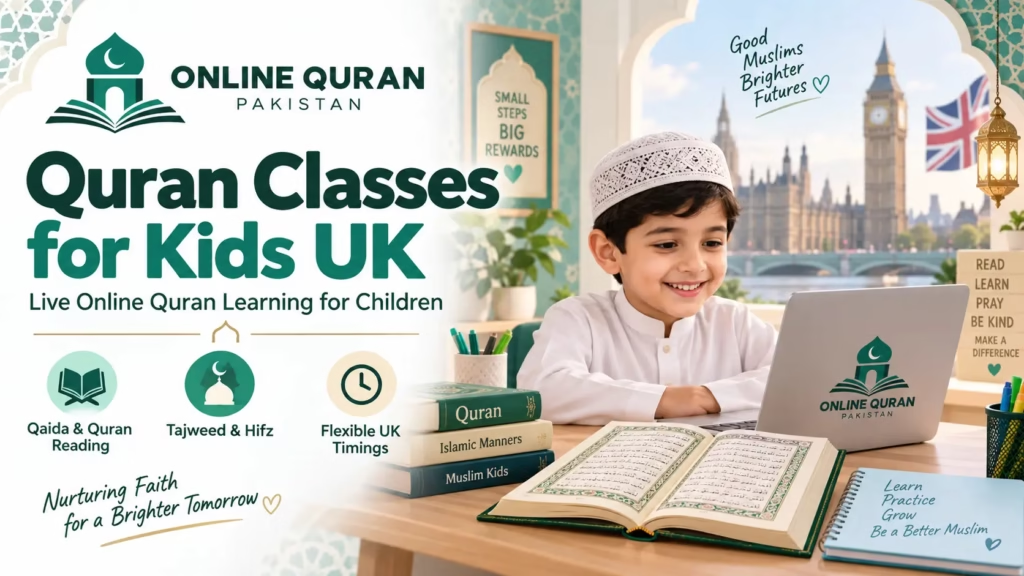
Quran Classes for Kids UK
Finding reliable Quran Classes for Kids UK can be challenging for parents who want their children to learn the Quran correctly while balancing school, homework, family commitments, and other activities.
Online Quran classes provide a practical way for children to learn from home with direct guidance from a Quran teacher. Whether your child is a complete beginner, already reading the Quran, learning Tajweed, or beginning Hifz, lessons can be adapted according to age, ability, and learning pace.
Our online Quran lessons for children are designed to help young learners build strong Quran-reading foundations, improve pronunciation, develop confidence, and gradually understand important Islamic teachings.
Children across London, Birmingham, Manchester, Bradford, Leicester, Leeds, Glasgow, Luton, Liverpool, Cardiff, and other areas of the UK can attend live Quran classes without travelling to a physical academy.
Parents who want to experience the teaching approach first can arrange a free trial Quran class before starting regular lessons.
Online Quran Classes for Kids in the UK
Modern family routines can make regular Quran education difficult.
Children may finish school in the afternoon, have homework in the evening, attend extracurricular activities, and need sufficient time for rest. Travelling several times each week to a local madrasa may not always fit comfortably into that routine.
Online Quran classes for kids in the UK make it easier to create a consistent learning schedule.
Instead of spending additional time travelling, children can join their Quran tutor from home using a computer, tablet, or other suitable device. Parents can choose a convenient class time and remain involved in their child’s learning.
Families who are looking for Quran education for adults or other household members can also explore broader Online Quran Classes UK.
The objective is simple: make Quran learning accessible, structured, and suitable for the child’s daily routine.
Why Online Quran Lessons Work Well for Children
Every child learns differently.
Some children quickly recognise Arabic letters but need extra help with pronunciation. Others pronounce letters well but struggle to join Arabic words. Some are already able to read the Quran but need regular Tajweed correction.
Personal online lessons allow the teacher to focus on the child’s specific needs.
Instead of moving at the speed of a large group, the lesson can progress according to the individual student’s ability. Difficult letters can be repeated, weak areas can receive more attention, and material that the child has already mastered does not need to be unnecessarily repeated.
This personalised approach can be particularly helpful for young learners who need encouragement and regular correction.
Parents can also monitor progress more easily because lessons take place at home.
Quran Classes for Complete Beginners
Children do not need previous Quran education before joining.
A complete beginner can start with Arabic letters and basic pronunciation before progressing toward Quran reading.
A teacher will normally first assess the child’s existing ability. Some children may recognise letters but not understand vowel signs. Others may already have completed part of a Qaida but still need pronunciation correction.
Starting from the correct level is important.
If lessons begin too far ahead, the child may feel confused. If they begin too far behind, the student may lose interest.
For children who are new to Arabic reading, a structured Qaida programme provides the foundation needed before reading complete Quranic verses.
Noorani Qaida for Kids
Noorani Qaida is one of the most common starting points for children learning Quranic Arabic.
The course introduces Arabic letters, their sounds, different letter forms, vowel signs, joining letters, Sukoon, Shaddah, Madd, and basic Quranic pronunciation.
These early lessons are important because mistakes learned at the beginning can become difficult to correct later.
A strong Qaida foundation helps children recognise Arabic words more confidently when they begin reading directly from the Quran.
If your child is starting from the alphabet or still needs stronger basic reading skills, you can learn more about the Noorani Qaida course.
Once these foundations become stable, children can gradually move toward independent Quran reading.
Quran Reading Classes for Kids UK
After completing the basic Qaida level, children can begin reading Quranic verses.
At this stage, the focus moves from recognising individual letters toward reading complete words and verses accurately.
Children learn how to connect words smoothly, pronounce letters correctly, recognise common Quranic patterns, and develop greater fluency.
Speed should not be the main priority.
A child who reads slowly but correctly is developing a stronger foundation than a child who rushes and repeatedly makes pronunciation mistakes.
Regular Quran lessons allow teachers to identify errors immediately and help the student practise difficult sections until the reading becomes more accurate.
This gradual approach helps children become more comfortable with Quran recitation and prepares them for more detailed Tajweed study.
Tajweed Classes for Kids UK
Tajweed is the study of correct Quran pronunciation and recitation.
For children, Tajweed should usually be introduced gradually rather than taught as a long collection of technical rules.
The teacher can explain rules while the child is actually reading. This makes it easier for young learners to understand how pronunciation rules apply in real Quranic verses.
Children may work on Makharij, Madd, Ghunnah, Qalqalah, Noon Sakinah, Meem Sakinah, stopping rules, and other important aspects of Quran recitation according to their level.
Correct pronunciation is particularly important because Arabic letters that appear similar may have different articulation points.
Regular listening and correction help students train both their tongue and their ear.
Children who are already reading Quran and want to improve accuracy can continue through a dedicated Online Tajweed Course.
Online Hifz Classes for Kids
Many UK parents also look for online Quran memorisation programmes for their children.
Hifz requires consistency, revision, and a realistic daily routine.
Memorising new verses is only one part of the process. Previously memorised Surahs must also be revised regularly so they remain strong.
A structured Hifz programme should therefore balance new memorisation with recent and older revision.
The amount assigned to each child should depend on reading ability, memory, age, school schedule, and available revision time.
Children should not be given unrealistic targets simply to progress faster.
Strong memorisation comes from repetition and regular revision.
Families interested in this pathway can explore Online Quran Memorization Classes for more information about Quran memorisation and revision.
Islamic Studies Alongside Quran Learning
Quran education can also help children develop basic Islamic knowledge.
Young learners often benefit from understanding the everyday teachings connected with the Quran and Muslim life.
Depending on age and course level, lessons may introduce daily duas, Islamic manners, Salah basics, stories of the Prophets, the life of Prophet Muhammad ﷺ, Ramadan, Islamic months, basic beliefs, and good character.
The objective should not be to overload children with too many subjects.
Instead, Islamic knowledge can be introduced naturally alongside Quran learning.
For example, a student memorising a short Surah can gradually learn its basic meaning. A child learning Salah can also practise the Surahs commonly used in prayer.
This helps children understand that Quran learning is connected with their everyday Islamic life.
Male and Female Quran Teachers for Children
Choosing the right teacher is one of the most important decisions parents make.
Some younger children may feel more comfortable learning with a female Quran teacher. Older boys may prefer a male tutor. Different families may also have their own preferences.
Parents can review available instructors through the Quran Teachers page.
More important than simply choosing a teacher is finding someone who can communicate clearly with children.
A good children’s Quran teacher should be patient, attentive, encouraging, and able to recognise when a child needs repetition rather than additional new material.
Young learners should feel comfortable reading aloud even when they make mistakes.
Correction is essential, but children should not become afraid of participating in the lesson.
Child-Friendly Quran Teaching
Teaching children online requires patience and engagement.
A child may not be able to concentrate for the same length of time as an adult. Younger students, in particular, benefit from lessons that are divided into manageable stages.
A teacher may begin by revising the previous lesson, then listen to the child’s current reading, correct important mistakes, practise difficult words, and finally introduce a suitable amount of new material.
Repetition is an important part of children’s Quran education.
A letter, word, or Tajweed rule may need to be practised several times before the child becomes comfortable with it.
The purpose is not to finish pages quickly.
The purpose is to develop accurate reading that remains strong as the child progresses.
Quran Lessons Around UK School Timings
Flexible scheduling is one of the main reasons families choose online learning.
Children in the UK often need class times that fit around school, homework, dinner, sports, and family routines.
Online lessons can be scheduled during suitable after-school or weekend periods depending on teacher availability.
Some children benefit from shorter classes several times each week. Others may prefer fewer sessions.
The right timetable depends on the child’s age and attention span.
Families looking specifically for teacher scheduling options can also visit the Online Quran Tutor UK page.
The most effective schedule is usually one that the child can follow consistently without feeling exhausted.
What Age Can Children Start Quran Classes?
There is no single perfect age for beginning Quran education.
Some children can start recognising Arabic letters at a young age, while others may benefit from waiting until they can concentrate more comfortably.
Readiness is more important than choosing an exact age.
If a child can listen, repeat sounds, recognise basic symbols, and follow simple teacher instructions, introductory Quran lessons may be suitable.
For younger children, the focus should remain on building familiarity and creating a positive learning experience.
Older beginners can often progress through the early stages more quickly because they already have stronger reading and study skills.
How Parents Can Support Quran Learning
Parents play an important role even when a professional teacher is conducting the lesson.
Children usually progress more consistently when the family creates a regular learning routine.
A quiet study space, a working device, reliable internet, punctual class attendance, and a few minutes of revision between lessons can make a significant difference.
Parents can also ask children what they learned, encourage them to practise, and stay in communication with the teacher.
Avoid comparing one child with another.
Two siblings may take very different amounts of time to reach the same Quran-reading level.
Consistent improvement is more important than competition.
Quran Classes for Primary-School Children
Primary-school students can gradually develop a strong Quran foundation through consistent lessons.
Depending on ability, they may work on Noorani Qaida, Quran reading, short Surahs, pronunciation, simple Tajweed, duas, and basic Islamic knowledge.
At this age, repetition and routine are especially useful.
Children may forget material when there are long gaps between lessons, so regular practice helps build stronger recognition and confidence.
Short home revision between classes can reinforce what the teacher has already taught.
Quran Lessons for Teenagers
Teenagers may require a different teaching approach from younger children.
Some teens already read Quran but need help correcting long-standing Tajweed mistakes. Others may have stopped attending Quran classes and want to begin again.
Teenage students may study fluent recitation, Tajweed, Hifz, revision, selected Islamic Studies topics, or Arabic according to their needs.
The teacher should respect the student’s age and existing knowledge rather than using exactly the same method used for a five-year-old beginner.
Benefits of Quran Classes for Kids UK
Choosing suitable Quran Classes for Kids UK can help children establish a consistent Quran-learning routine while remaining comfortable at home.
The main benefits include live teacher interaction, individual correction, flexible UK timings, access to male and female tutors, beginner Qaida lessons, Quran reading, Tajweed, memorisation, Islamic learning, parent involvement, and the ability to study without regular travel.
Online learning is not about replacing the importance of teachers.
It is about making direct teacher guidance more accessible for families whose schedules or locations make traditional classes difficult.
Quran Class Fees in the UK
Course fees may depend on lesson frequency and the selected study plan.
Rather than placing prices throughout the course page, parents can view the latest available plans on the dedicated UK Quran Class Fees page.
This keeps pricing information separate from the learning content and makes it easier to compare available options.
Try a Quran Class Before Enrolling
A trial lesson is one of the best ways to determine whether a teacher and learning format are suitable for your child.
Parents can observe how the tutor communicates, whether the child feels comfortable, how mistakes are corrected, and whether the lesson pace is appropriate.
It also gives the teacher an opportunity to understand the student’s current Quran-reading level.
You can book a free trial Quran class before deciding on regular lessons.
Frequently Asked Questions About Quran Classes for Kids UK
Can my child join Quran classes without knowing Arabic?
Yes. Complete beginners can start with Arabic letters and Noorani Qaida before progressing to Quran reading.
Are online Quran classes suitable for young children?
Yes, provided lessons are adapted to the child’s age, attention span, and learning level. Younger learners generally benefit from clear, focused sessions and regular repetition.
Can children learn Tajweed online?
Yes. A teacher can listen to the student’s recitation during a live lesson, demonstrate correct pronunciation, and provide immediate Tajweed correction.
Are female Quran teachers available?
Male and female tutors are available. Parents can request their preferred option according to availability.
Can my child learn Hifz online?
Yes. Online Hifz lessons can combine new memorisation with structured revision of previously memorised Quran.
Are classes available across the UK?
Yes. Because lessons take place online, children can study from different cities and regions throughout the United Kingdom.
How often should children take Quran lessons?
The ideal frequency depends on the child’s level, age, goals, and family routine. Regular classes combined with short revision between lessons generally produce better consistency than irregular study.
Start Quran Classes for Your Child
The right Quran education can help a child develop accurate recitation, stronger Islamic habits, confidence, and a lasting connection with the Quran.
Whether your child is learning the Arabic alphabet, progressing through Noorani Qaida, beginning Quran recitation, improving Tajweed, or memorising Surahs, a structured learning plan can make the journey easier.
Our Quran Classes for Kids UK are designed to provide live guidance while allowing families to choose a schedule that works around everyday life.
Parents do not need to commit immediately.
Start with a free trial class and allow your child to experience the lesson first.