
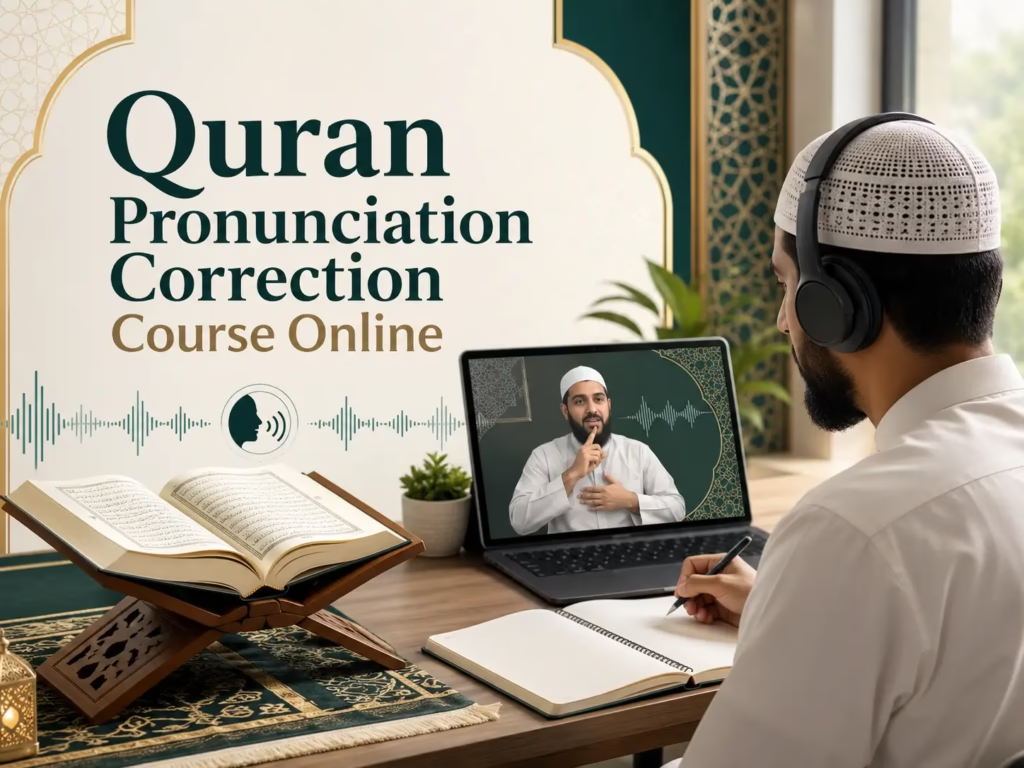
A Quran pronunciation correction course online helps you identify and fix mistakes in Arabic letters, words, Tajweed rules, pauses, and recitation flow. Instead of practicing alone and repeating the same errors, you read directly to a qualified Quran teacher who listens carefully, explains the problem, demonstrates the correct sound, and guides you through focused repetition.
This type of course can benefit children, adults, beginners, returning learners, new Muslims, Hifz students, and anyone who wants to read the Quran more accurately. You do not need a beautiful voice or an advanced knowledge of Arabic. You only need a willingness to learn, practice, and accept correction patiently.
Allah instructs believers to recite the Quran in a measured and careful manner in Surah Al-Muzzammil, verse 4. This emphasis on deliberate recitation shows why accuracy, clarity, and steady learning matter.
What Is a Quran Pronunciation Correction Course?
A Quran pronunciation correction course is a structured learning program focused on improving how you produce Arabic letters and recite Quranic words.
The teacher first listens to your current recitation. This initial assessment helps identify whether your main difficulties involve:
- Arabic letter pronunciation
- Makharij, or articulation points
- Sifaat, or letter characteristics
- Short and long vowels
- Heavy and light letters
- Ghunnah, or nasal sound
- Madd, or lengthening
- Tajweed application
- Stopping and restarting
- Reading speed and fluency
The course is then adjusted according to your level. A complete beginner may start with individual Arabic letters, while an intermediate learner may work directly on verses, surahs, and recurring Tajweed mistakes.
The purpose is not simply to memorize pronunciation rules. The goal is to train your mouth, tongue, lips, throat, breath, and listening skills so correct recitation becomes natural with practice.
Why Correct Quran Pronunciation Matters
Arabic contains sounds that do not exist in English, Urdu, and many other languages. As a result, learners often replace unfamiliar Arabic letters with sounds from their first language.
For example, a student may pronounce:
- ح like ه
- ع like ا
- ق like ك
- ص like س
- ض like د or ز
- ط like ت
- ظ like ز
- ث like س
- ذ like ز
These letters may sound similar to an untrained listener, but they come from different articulation points and carry different qualities.
Correct pronunciation matters because changing a letter can change the word being recited. Not every small mistake changes the meaning, but learners should still work toward giving each letter its proper sound.
A pronunciation course helps you approach correction without fear. Struggling does not mean you should stop reading. A well-known hadith encourages learners by explaining that a person who finds Quran recitation difficult while continuing to work at it receives a double reward.
Who Should Take an Online Quran Pronunciation Course?
A pronunciation correction course is suitable for learners at many different stages.
Complete beginners
Beginners may recognize Arabic letters but struggle to pronounce them from the correct place. A teacher can help them build a strong foundation before mistakes become permanent habits.
Adults returning to Quran learning
Many adults learned Quran reading during childhood but stopped practicing regularly. They may still read fluently while making repeated pronunciation or Tajweed mistakes.
A correction course helps them review the basics without forcing them to restart everything unnecessarily.
Children learning Quran
Children often imitate sounds quickly, which makes early correction valuable. A patient teacher can correct mistakes through short exercises, repetition, and age-appropriate practice.
New Muslims
New Muslims may be learning Arabic sounds for the first time. They need a supportive course that explains pronunciation clearly without assuming prior knowledge.
Hifz students
A memorization student may repeat the same pronunciation error hundreds of times. Correcting that mistake later can be difficult because it has become connected to the memorized verse.
Pronunciation correction should therefore remain part of both new memorization and daily revision.
Learners who understand Tajweed but cannot apply it
Some students can define Idgham, Ikhfa, Ghunnah, and Madd but still struggle to apply these rules while reading. They need practical recitation correction rather than more theory alone.
Imams, teachers, and advanced students
Advanced readers may seek refinement in letter qualities, timing, stopping, breath control, and consistency. Their course may focus on subtle errors rather than basic reading.
Common Quran Pronunciation Mistakes
Every learner has a different reading pattern, but certain mistakes appear frequently.
1. Using the Wrong Articulation Point
The articulation point is the place from which a letter is produced. This is called its makhraj.
Arabic letters are produced from areas including:
- The throat
- The tongue
- The lips
- The nasal passage
- The empty space of the mouth and throat
When a letter is produced from the wrong place, it may sound like another letter. A teacher may ask you to slow down, isolate the sound, observe the tongue position, and repeat the letter with different vowels.
2. Confusing Similar Arabic Letters
Pairs such as س and ص or ت and ط may appear similar to beginners. The difference is not only in where the sound begins but also in its strength, heaviness, airflow, and other characteristics.
A correction course usually compares these letters directly so the learner can hear and feel the difference.
3. Making Heavy Letters Too Light
Letters such as خ, ص, ض, غ, ط, ق, and ظ generally carry heaviness. Learners sometimes pronounce them using a lighter sound from their native language.
The teacher demonstrates how the back of the tongue and the space inside the mouth affect the sound.
4. Making Light Letters Too Heavy
Students may also add unnecessary heaviness to letters that should remain light. This can make the entire recitation sound forced.
Correction involves learning when the mouth should remain relaxed and when elevation of the tongue is required.
5. Stretching Short Vowels
A short vowel should not automatically become a long vowel. Extending a Fathah, Kasrah, or Dammah for too long can alter the structure of a word.
Students often make this mistake when reading slowly or trying to create a melodic sound.
6. Cutting Long Vowels Too Short
The opposite problem occurs when a learner does not give a Madd its required length. The teacher may use beats, finger counting, or repeated examples to develop consistent timing.
7. Weak or Excessive Ghunnah
Ghunnah is a nasal sound used in specific recitation situations. Some learners remove it completely, while others extend it too much or apply it where it does not belong.
Practical listening and repetition help the learner control both the sound and its duration.
8. Ignoring Sukoon and Shaddah
A letter with Sukoon must be handled differently from a moving letter. A letter with Shaddah requires proper emphasis because it represents a doubled consonant.
Ignoring these signs can make words sound incomplete or unclear.
9. Stopping at the Wrong Place
Correct Quran reading also includes knowing where to pause and how to resume. Stopping at an unsuitable place may interrupt the meaning or create an incomplete phrase.
A structured course teaches common Quran stopping symbols and introduces the principles of Waqf and Ibtida, meaning stopping and beginning.
10. Reading Too Quickly
Some students focus on finishing a page rather than pronouncing each word clearly. Speed can hide weak letters, missed vowels, shortened Madd, and incorrect stops.
Slow, measured recitation makes mistakes easier to notice and correct.
What You Learn in a Quran Pronunciation Correction Course Online
A well-structured course normally moves from sound recognition to practical Quran recitation.
Initial recitation assessment
The teacher asks you to read a short passage. The purpose is not to judge or embarrass you. It is to identify your current level and recurring mistakes.
The assessment may examine:
- Letter recognition
- Pronunciation
- Reading accuracy
- Tajweed knowledge
- Fluency
- Breath control
- Stopping habits
- Confidence while reading aloud
Arabic letter correction
You practice difficult letters individually before reading them inside words. The teacher explains where the tongue, lips, or throat should be positioned.
Makharij training
Makharij training teaches the correct articulation point of each letter. It is one of the main foundations of accurate recitation.
A teacher may use visual demonstrations, mouth-position explanations, mirror exercises, and sound comparisons to make the articulation clearer.
Sifaat training
Sifaat are the characteristics of Arabic letters. They explain qualities such as strength, softness, airflow, heaviness, and elevation.
Understanding these qualities helps learners distinguish letters that share nearby articulation points.
Word-level correction
After practicing individual sounds, you apply them inside Quranic words. This stage is important because a learner may pronounce a letter correctly by itself but lose the sound when connecting it to other letters.
Tajweed application
The course gradually applies rules such as:
- Noon Sakinah and Tanween
- Meem Sakinah
- Ghunnah
- Qalqalah
- Madd
- Heavy and light letters
- Rules of Raa
- Rules of Laam
- Stopping signs
- Waqf and Ibtida
Verse and surah practice
You read selected verses and short surahs while the teacher corrects mistakes in real time. Familiar surahs are often useful because students may have repeated their existing mistakes for years without noticing them.
Fluency development
Once pronunciation improves, the teacher helps you connect words more smoothly without rushing or losing accuracy.
Personal revision plan
Your teacher may give you a short list of sounds, words, or verses to practice between lessons. This focused approach is usually more effective than reading several pages without knowing what to correct.
How Online Pronunciation Correction Classes Work
Online learning makes Quran correction accessible to students who do not have a suitable local teacher.
Most classes follow a simple process.
Step 1: Join the live session
You connect with your teacher through a video or audio platform. Clear sound is important because the teacher must hear small pronunciation differences.
Step 2: Review previous corrections
The lesson begins by revisiting the mistakes identified in the previous class.
Step 3: Practice target sounds
You repeat selected letters, words, or rules. The teacher demonstrates each sound and listens to your attempt.
Step 4: Read from the Quran
You read a passage while the teacher marks mistakes and provides immediate correction.
Step 5: Repeat the corrected word
Instead of continuing immediately, you repeat the word or phrase until the sound improves.
Step 6: Receive practice work
The teacher assigns a manageable exercise for the next lesson.
Live teacher feedback is especially useful because learners may not hear their own mistakes accurately. Recorded lessons and recitation applications can support practice, but they may not explain exactly why a sound is incorrect or how an individual learner should adjust the mouth and tongue. Research into automated Quran recitation assessment also notes that useful correction requires more than recognizing words. It must consider phonetic details, Tajweed rules, and articulation characteristics.
Online Course vs Self-Study
Listening to skilled reciters is an excellent learning habit. Apps, recordings, books, and videos can also help you review rules and hear correct models.
However, self-study has one major limitation: you may continue repeating a mistake because it sounds correct to you.
A qualified teacher can:
- Identify the exact letter being mispronounced
- Explain the cause of the error
- Demonstrate the correct sound
- Observe your mouth position through video
- Ask you to repeat the sound immediately
- Track whether the mistake returns
- Adjust exercises to your first language and ability
The best approach combines direct teacher correction with regular independent listening and practice.
Benefits of Learning Quran Pronunciation Online
Personalized correction
A private teacher can spend more time on the sounds you find difficult instead of following a general lesson for the entire group.
Flexible scheduling
Online classes can be arranged around school, employment, family responsibilities, and time-zone differences.
Access to qualified teachers
You can study with a suitable male or female Quran teacher even when qualified tutors are not available nearby.
A private learning environment
Adults and beginners may feel nervous reading in front of a group. One-to-one classes provide space to make mistakes without embarrassment.
Recorded progress
Students can keep a pronunciation notebook or audio recordings to compare their reading over time.
Consistent learning
Regular online appointments create accountability and reduce the risk of postponing practice.
How Long Does Pronunciation Correction Take?
There is no single timeline for every student.
The duration depends on:
- Your starting level
- The number of mistakes you make
- How long you have repeated those mistakes
- Your familiarity with Arabic
- Lesson frequency
- Practice between classes
- Your ability to hear sound differences
- The level of accuracy you want to reach
Some learners notice improvement in several weeks, while deeply established mistakes may require months of focused practice.
Rather than asking only how quickly you can complete the course, ask whether your pronunciation is becoming clearer and more consistent.
How Often Should You Take Classes?
For many learners, two or three lessons per week provide a useful balance between instruction and practice.
Young children may benefit from shorter but more frequent sessions. Adults with established mistakes may need focused lessons followed by daily independent repetition.
A simple routine could include:
- 15 to 20 minutes of daily practice
- Two or three live lessons each week
- One weekly recording to monitor progress
- Regular review of corrected words
- Listening to a reliable reciter before repeating a passage
Consistency matters more than practicing for several hours once and then stopping for a week.
A Simple Daily Pronunciation Practice Routine
Listen for three minutes
Choose a short passage and listen carefully to a skilled reciter. Focus on clarity rather than melody.
Repeat individual words for five minutes
Select the words your teacher corrected. Repeat them slowly without rushing.
Practice one difficult letter for five minutes
Read the letter with Fathah, Kasrah, Dammah, Sukoon, and Shaddah.
Read aloud for five minutes
Read several lines from the Quran while applying the correction.
Record and review for two minutes
Listen to your recitation and compare it with the model. Note any sound that still feels unclear.
This short routine can be more productive than reading a large amount without focused correction.
How to Choose the Right Online Course
Not every class labeled as a Tajweed course provides detailed pronunciation correction. Ask the academy or teacher the following questions before enrolling.
Does the course begin with an assessment?
The teacher should understand your current level before choosing lessons.
Are classes live?
Recorded material is helpful, but live correction should be available if pronunciation improvement is the main goal.
Does the teacher explain Makharij?
The course should teach how sounds are physically produced, not only point out that a word is wrong.
Will I receive individual feedback?
You need to know which mistakes you personally make and how to fix them.
Is the teacher qualified to teach Tajweed?
Ask about the teacher’s Quran education, Tajweed training, teaching experience, and ability to work with learners at your level.
Can the teacher communicate clearly?
A knowledgeable teacher must also be able to explain difficult sounds patiently and understandably.
Are classes suitable for my age and ability?
Children, adult beginners, Hifz students, and advanced reciters require different teaching methods.
Is progress reviewed regularly?
The course should include periodic reassessment so you can see which errors have improved and which still need attention.
Can Children Take a Quran Pronunciation Correction Course?
Yes. Children can take pronunciation correction classes as soon as they begin learning Arabic letters and Quran reading.
Early correction can prevent habits such as:
- Replacing difficult Arabic letters
- Stretching every vowel
- Reading too quickly
- Ignoring Sukoon or Shaddah
- Memorizing surahs with incorrect sounds
Children usually learn best through short sessions, repetition, encouragement, visual explanation, and regular communication between the teacher and parents.
Parents should avoid placing too much pressure on immediate perfection. Clear improvement, consistency, and a positive relationship with Quran learning are important.
Can Adults Correct Pronunciation After Many Years?
Yes. Adults can improve Quran pronunciation even when they have repeated the same mistakes for a long time.
The process may require patience because the tongue has developed familiar movement patterns. The learner must first recognize the mistake, then produce the correct sound slowly, and finally apply it consistently during normal recitation.
Adults often make faster progress when they are willing to slow down and temporarily reduce the amount they read.
Reading one page carefully can be more beneficial for correction than reading ten pages while repeating the same error.
Is a Beautiful Voice Required?
No. Correct Quran pronunciation is not the same as having a naturally melodic voice.
The first priorities are:
- Correct letters
- Clear vowels
- Proper lengthening
- Accurate Tajweed
- Suitable stopping
- Steady recitation
A pleasant voice can enhance recitation, and a hadith encourages Muslims to beautify Quran recitation with their voices. However, learners should not imitate complex melodies at the expense of accurate letters and rules.
Start Improving Your Quran Recitation
Pronunciation mistakes should not make you feel ashamed or prevent you from reading the Quran. Every learner begins at a different level, and improvement develops through listening, correction, repetition, and patience.
A Quran pronunciation correction course online gives you direct access to a teacher who can identify mistakes you may not notice on your own. With structured lessons and regular practice, you can strengthen your Makharij, apply Tajweed more confidently, improve fluency, and recite with greater care.
To begin, request a Quran reading assessment from Online Quran Pakistan. A teacher can listen to your recitation, identify your main pronunciation difficulties, and recommend a suitable learning plan.
Frequently Asked Questions
What is Quran pronunciation correction?
Quran pronunciation correction is the process of identifying and fixing errors in Arabic letters, vowels, articulation points, letter qualities, Tajweed rules, and stopping. A teacher listens to the student and provides direct guidance and repetition exercises.
Can I learn correct Quran pronunciation online?
Yes. Live online classes allow a teacher to hear your recitation, demonstrate correct sounds, observe mouth movement when necessary, and correct mistakes in real time.
Do I need to know Tajweed before joining?
No. Beginners can start with Arabic letters and basic Makharij. Students who already know Tajweed can focus on practical application and advanced correction.
Is this course suitable for complete beginners?
Yes. Complete beginners can begin with letter recognition, vowels, joining letters, and correct articulation before moving to Quranic words and verses.
Can adults improve Quran pronunciation?
Yes. Adults can correct long-standing pronunciation habits through slow practice, teacher feedback, repeated sound exercises, and consistent revision.
How many classes do I need each week?
Many students benefit from two or three classes per week. The ideal frequency depends on age, level, goals, availability, and the amount of practice completed between lessons.
What is the difference between Makharij and Tajweed?
Makharij refers to the articulation points from which Arabic letters are produced. Tajweed is broader and includes Makharij, letter characteristics, lengthening, nasal sounds, merging rules, stopping, and other principles of correct Quran recitation.
Can an app correct my Quran pronunciation?
An app can help with listening, repetition, and basic error detection. However, a qualified teacher can usually provide more specific explanations and personalized correction, especially for subtle articulation and Tajweed errors.
How can I practice Quran pronunciation at home?
Listen to a reliable reciter, repeat short sections slowly, practice difficult letters separately, record your voice, review corrections from your teacher, and avoid rushing through long passages.
How do I know whether my pronunciation is improving?
You should notice fewer repeated corrections, clearer differences between similar letters, more consistent Madd and Ghunnah, better stopping, and greater confidence while reading aloud.